Licensed and Insured. Holding permits through the MN DNR
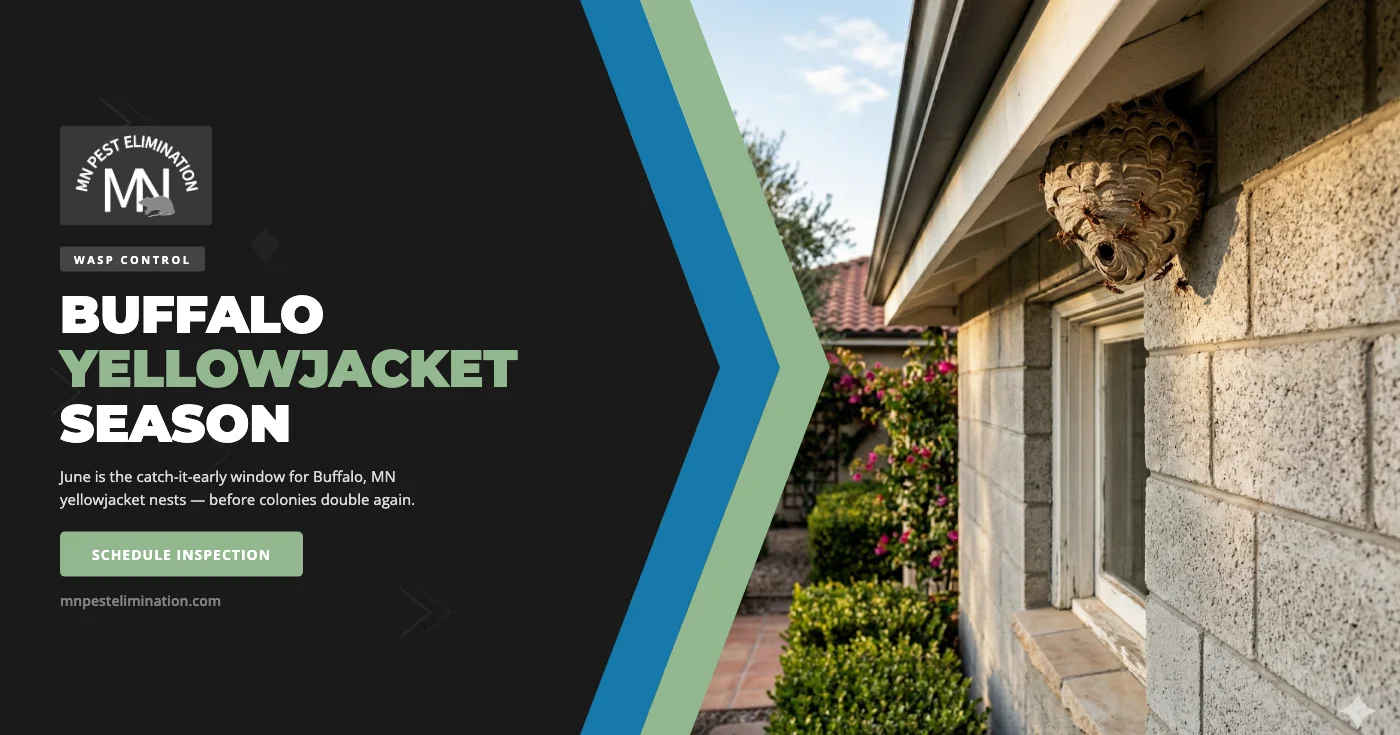
By the second week of June, the yellowjacket situation in Buffalo, MN has officially shifted. The queens that spent April building their first nests now have their first batch of workers out hunting, expanding the colony, and starting to defend territory. We see the call volume jump every year right around this point, and most of the calls start the same way: "There weren't any wasps here last week, and now there's a bunch coming and going from the same spot." That is exactly what colony takeoff looks like, and it is why June is the most important month for yellowjacket control Buffalo MN homeowners can actually get ahead of.
Most homeowners assume wasp problems are a July or August issue. By the time you are dodging yellowjackets at the grill in August, the colony has been growing quietly for ten weeks. According to the University of Minnesota Extension, every yellowjacket colony you see in late summer was started by a single queen in spring, and the colony grows on a sharp exponential curve once the first workers emerge. June is the inflection point. The nest you could have knocked out with one quick visit in late May becomes a 50- to 100-worker operation by mid-June and a 1,000-plus colony by August.
Buffalo sits in the heart of Wright County, with hundreds of homes backing onto Buffalo Lake, Lake Pulaski, and shoreline woodlots — all prime overwintering habitat for queens. Add in the cool, wet May we just came out of, and queens that founded slow in spring are now playing catch-up. We are seeing activity spike across our service area this week, from Buffalo through Montrose, Howard Lake, and Annandale.
Here is what most homeowners do not realize about how a yellowjacket colony grows in Minnesota. After a queen survives winter, she emerges alone in late April or early May. For roughly 30 days, she does every job herself — chewing wood pulp, building the first cells, laying eggs, and hunting soft-bodied insects to feed her larvae. June is where everything changes. Her first batch of 10 to 30 sterile female workers emerges and immediately takes over construction, foraging, and nest defense. The queen retreats to do nothing but lay eggs from that point forward.
With workers in the air, the nest can double every couple of weeks. A founding cluster the size of a golf ball in late May is the size of a softball by mid-June and basketball-sized or larger by August. We are no longer dealing with one insect on a paper cup; we are dealing with an active, defended colony on a regular flight path. The window for catching a Minnesota wasp season problem early is closing fast.
One of the things that makes Wright County wasp control tricky in June is that yellowjackets nest in places paper wasps usually do not. Paper wasps hang out in the open under a soffit or pergola. Yellowjacket nests are almost always enclosed and hidden. On a typical Buffalo property, the high-risk spots are predictable:
To find a hidden nest, watch the property at midday for ten minutes. Workers follow a tight flight line in and out, and the entry hole is almost always smaller than you think.
Treatment depends on what you are actually dealing with, and yellowjackets get blamed for a lot of stings caused by their cousins. Here is how we sort them on a typical Buffalo service call.
Yellowjackets are short, stocky, and brightly yellow-and-black with a sharp, defined waist. They tuck their legs in tight when flying, so they look like a fast-moving blur. Their nests are enclosed in a papery shell and almost always hidden — underground, inside a wall void, or deep in a shed cavity. They are highly aggressive in defense and account for the majority of summer wasp stings in Minnesota.
Paper wasps are slender and brown with yellow markings, with long legs that hang down when they fly. Their nests are open umbrella-shaped clusters where you can see right into the cells, usually under a soffit or pergola beam. They are far less aggressive — they sting only if you bump the nest or grab one. The European paper wasp, which the UMN Extension flags as widespread in Minnesota now, looks yellower and is often confused for a yellowjacket.
Bald-faced hornets are not really hornets — they are a large, black-and-white yellowjacket species with cream-white face and abdomen markings. They build the football-shaped gray paper nests you see hanging from tree branches and high under eaves, and they respond to the same treatment approach.
The question we hear most often in June is whether yellowjackets are really more aggressive than other wasps. The answer is yes, and there is a specific biological reason. Unlike honey bees, yellowjackets do not lose their stinger after one strike — a single worker can sting repeatedly. More importantly, a disturbed yellowjacket releases an alarm pheromone that recruits the rest of the colony to attack in a group. One stepped-on underground nest can mobilize 50 workers in seconds.
By mid-June, that defensive response is no longer theoretical. Colonies have enough workers to mount a real swarm, and they will pursue a perceived threat 50 feet or more from the nest — exactly the distance from a soffit to a swing set in most Buffalo yards. According to the CDC, severe allergic reactions to wasp and hornet stings send tens of thousands of Americans to emergency rooms every year, and yellowjackets cause the bulk of them. For dogs, the risk is higher than most owners realize — a dog that snaps at a yellowjacket gets stung in the mouth or throat, where swelling can quickly become a medical emergency.
We get this call almost every week from June through September: "I sprayed the nest last night and now there are wasps everywhere — and they are angry." Consumer wasp sprays only knock down the workers sitting on the visible portion of the nest at the moment you spray. With yellowjackets, almost nothing is visible — the nest is inside a wall, soffit, or underground chamber. The aerosol cannot reach the queen or brood, and it has almost no residual effect once the propellant evaporates. So you kill maybe 20 to 30 percent of the workers, and you do three things that make the problem dramatically worse:
Underground nests are essentially impossible to treat with a consumer aerosol — the entrance is too narrow for the spray to reach the chamber, and the homeowner stands well within the defensive radius the entire time. Every summer we treat properties where a DIY attempt the night before turned a manageable mid-June nest into a much larger July problem.
Our June yellowjacket protocol is built for the colony-takeoff window we are in right now. When you call us for wasp nest removal in Wright County MN, we walk the full property — every soffit, gable, shed corner, play set, plus a slow sweep of the lawn edges for in-ground entry holes — and identify every active colony, including the ones a homeowner has not noticed.
Then we apply a targeted, professional-grade treatment with the right delivery tool for the nest location. For wall-void and soffit nests, that means a duster that pushes treatment deep into the cavity. For exposed paper nests, we use a fast-knockdown application that drops the colony at once instead of triggering a defensive cloud. For in-ground nests, we use a closed-system delivery that treats the chamber from outside the colony's defensive radius. After the nest is dead, we remove the physical structure where reachable and apply a residual perimeter treatment to discourage new queens later in the season. See the full scope on our wasp control service page, or learn more at MN Pest Elimination.
It is the opposite — June is the ideal window. Colonies have grown large enough that the nest is locatable, but small enough that one professional visit shuts it down before defense numbers explode. Waiting until August means dealing with a colony 10 to 20 times larger.
Watch for a steady stream of yellow-and-black wasps coming and going from a single small hole in the lawn, mulch bed, or landscaping edge — often no bigger than a dime. A consistent flight line into the same spot over a midday hour is the clearest sign. Do not poke at the hole to confirm.
No. Yellowjackets are predators, not pollinators — they hunt soft-bodied insects to feed their larvae and scavenge meat and sugar in late summer. Honey bees and bumble bees are pollinators, and we never treat them as a pest. If you find honey bees on your Buffalo property, we refer you to a local beekeeper for live removal. We treat wasps; we protect bees.
Yes, and the gap widens as the season progresses. Yellowjackets attack as a coordinated group, sting repeatedly, and defend a much larger radius around the nest than paper wasps do. By August, when colonies peak and natural food sources drop, they become outright hostile around picnics, garbage cans, and pet bowls. Catching nests in June prevents most of that.
June is the one month where Buffalo homeowners still have leverage over yellowjackets. Colonies are big enough to find and small enough to shut down in one visit. By July, the math flips hard in the colony's favor — and the risk of a multi-sting incident in your own yard goes up every week.
If you have noticed wasps coming and going from the same spot on your house, shed, or lawn — or just want a professional inspection before the Fourth of July weekend — reach out to MN Pest Elimination today. We serve Buffalo, Waverly, Montrose, Delano, Howard Lake, Annandale, Rockford, Hanover, and Clearwater. We will walk your property, find what is active, and shut it down before it doubles again.