Licensed and Insured. Holding permits through the MN DNR
Late June is when the spider calls really start picking up around Clearwater. Cabins that were quiet through Memorial Day suddenly have webs strung across every screen porch corner, fishing spiders on dock posts, and wolf spiders darting across cabin floors at night. That timing tracks the lakeside insect explosion on the Clearwater chain and across Wright County, which is exactly why summer spiders Clearwater MN lake-home owners ask us about every year are the most active spiders in the region. Here is what we are seeing on local properties and how we keep them off your cabin, deck, and boathouse for the rest of the season.
Lake homes attract more spiders in summer for one simple reason — they attract more insects, and spiders go wherever the food is. The shoreline along Clearwater Lake, Grass Lake, Sugar Lake, and the Mississippi River produces a nightly hatch of midges, mayflies, mosquitoes, and other soft-bodied insects from late May through September. Every porch light, dock light, and lit window on the lake side of a cabin pulls those insects in, and the spiders follow within days.
The other factor is humidity. Lakefront cabins hold moisture in basements, crawlspaces, boathouses, and shaded north walls — exactly the microclimates spiders prefer. Combine that with a nightly insect buffet and a lake property can easily host ten times the spider population of a comparable inland home in town. We see the same pattern every year from Clearwater up through Annandale and across to Buffalo: the closer to the water, the heavier the pressure.
The species you see on a Clearwater lake home are predictable enough that we can usually tell which spider is at work from a photo. According to the University of Minnesota Extension, the most common spiders found across Minnesota are orb weavers, jumping spiders, cobweb spiders, wolf spiders, fishing spiders, and crab spiders — and every one of those shows up on Wright County lake properties through summer.
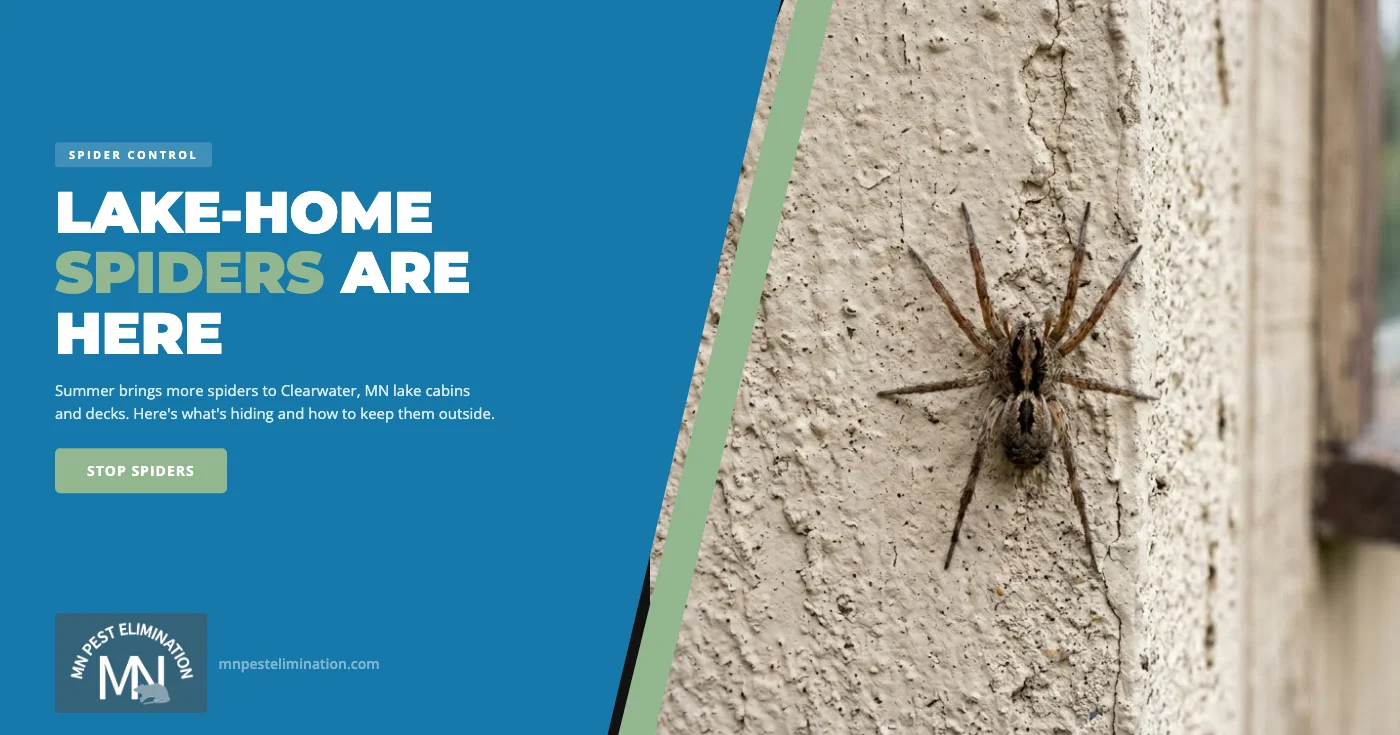
Wolf spiders are the big, brown, fast-moving ground hunters that startle cabin owners in the middle of the night. They run between a quarter inch and a full inch long, do not build webs, and chase prey across decks, walkways, and basement floors. They are not aggressive and almost never bite unless directly handled, but their size and speed make them the spider we hear about most.
Fishing spiders are the largest spiders in the Upper Midwest. A full-grown female can be an inch across the body with a leg span approaching three to four inches. They live right on the shoreline, run across the surface of the water on velvet-coated legs, and routinely show up on dock posts, boathouse walls, and the underside of pontoon railings. June and July are their peak months on the Clearwater chain.
Orb weavers are responsible for the classic round, spoked webs that appear overnight across screen porches, deck railings, and between dock pilings. The barn spider — the species Charlotte was modeled on in Charlotte's Web — is a common Wright County orb weaver and can build a web two feet across in a single night.
Cobweb spiders, American house spiders, and cellar spiders are the ones that actually establish indoors. Cobweb species build the tangled webs in basement corners and shed rafters. Cellar spiders are the long-legged "daddy-longlegs-looking" spiders that hang upside down in crawlspaces — harmless, and one of the few spiders that prey on other spiders.
Here is the reassurance most Clearwater homeowners are really looking for: neither black widow nor brown recluse spiders are native to the upper Midwest. The UMN Extension is explicit on this point. The vast majority of "spider bite" diagnoses in Minnesota turn out to be something else entirely.
To understand why spider numbers spike around Clearwater in late June, you have to look at what they are eating. Every shallow bay on a Minnesota lake produces enormous nightly hatches of non-biting midges, mayflies, caddisflies, mosquitoes, and tiny moths from late spring through early fall. On a calm evening in June, you can watch a swarm column rise off the water at dusk containing tens of thousands of insects.
Those bugs do not stay over the water. They follow porch lights, dock lights, and lit cabin windows toward shore and pile up against any vertical surface they hit — soffits, siding, eaves, screen doors, boathouse walls. Within a few nights of a steady insect supply, web-builders move in. By the Fourth of July, a single porch corner can host three or four active orb weaver webs rebuilt every night.
This is why spider control Clearwater MN homeowners try in late summer often feels like it is not working. If the underlying insect supply has not been addressed, knocking down the visible webs does nothing — the same spiders, or replacements, are back in three days.
Spiders are predictable about where they set up shop on a lake home. When we inspect a Clearwater property in June, the hot spots are almost always the same:
If you are seeing webs in any of these spots multiplying week over week, the underlying population is well past the point a single can of spray will solve.
There is a lot homeowners can do between visits to keep spider numbers down. None of these eliminate the problem on a lakefront property — the insect supply is just too constant — but they meaningfully reduce the population we have to manage.
DIY measures buy you a lot on a lake home, but they hit a ceiling fast. If you are sweeping the same screen porch every Saturday and the webs are back by Wednesday, the population is past the level a homeowner can manage alone. The same is true if you are seeing fishing spiders on dock posts every morning, wolf spiders on the cabin floor at night, or webs accumulating faster than you can knock them down.
A professional Wright County spider exterminator treats the property in layers. We start with a full perimeter inspection — every soffit, eave, sill plate, window well, dock structure, and shed corner — to map the active species and the conditions feeding them. Then we apply a low-impact, residual exterior treatment along the foundation, eaves, and the shaded lake-facing wall where spiders hunt. For interior issues, we treat basements, crawlspaces, and utility penetrations with targeted applications gentle around pets and families. Finally, we set a schedule matched to the lake's insect cycle — typically two to three visits across the warm season.
Most Clearwater cabins and year-round lake homes do best on a quarterly plan that catches the spring population before it explodes, the midsummer surge before the Fourth of July, and the fall in-migration when spiders move toward shelter ahead of winter.
Lake homes attract heavy nightly insect activity — midges, mosquitoes, mayflies, and moths drawn to porch lights and lit windows. Where the bugs go, the spiders follow. A lakefront property in Wright County can easily host ten times the spider population of an inland home in town simply because the food supply is constant from late May through September.
Neither is a medical threat to people in any meaningful sense. Both species look intimidating because of their size, but they are not aggressive and almost never bite unless directly handled or trapped against skin. The UMN Extension confirms that neither black widow nor brown recluse spiders are native to the upper Midwest, so most large dark spiders Minnesota homeowners encounter are wolf spiders or fishing spiders — startling, not hazardous.
The single biggest lever is cutting down lake-facing light after dark, because every insect you attract becomes a spider meal. Pair that with weekly web sweeps on porches and dock pilings, sealed gaps around utility pass-throughs, and humidity control in basements. For seasonal cabins that sit unoccupied, a professional perimeter treatment every six to eight weeks prevents populations from building up while you are away.
Late June through early September is peak season on Clearwater lake properties. The first big surge tracks the mayfly and midge hatches in early June, populations peak around mid-July to early August, and the fall in-migration begins in September as spiders look for sheltered places to overwinter. Treatment timing matters — getting ahead of June is far easier than catching up in August.
Spider pressure on a Wright County lake home is not something a homeowner can fully eliminate — the insect supply along the shoreline guarantees a steady population every summer. But it is absolutely something we can manage down to the point where the screen porch stays clear, the dock is usable, and the cabin floors are not a midnight surprise.
If you are dealing with webs faster than you can sweep them, fishing spiders on the dock, or wolf spiders inside the cabin, reach out to MN Pest Elimination today. We serve Clearwater, Annandale, Buffalo, Waverly, Montrose, Delano, Howard Lake, Hanover, Rockford, and the surrounding Wright County lake country with a summer spider program built for shoreline homes.