Licensed and Insured. Holding permits through the MN DNR
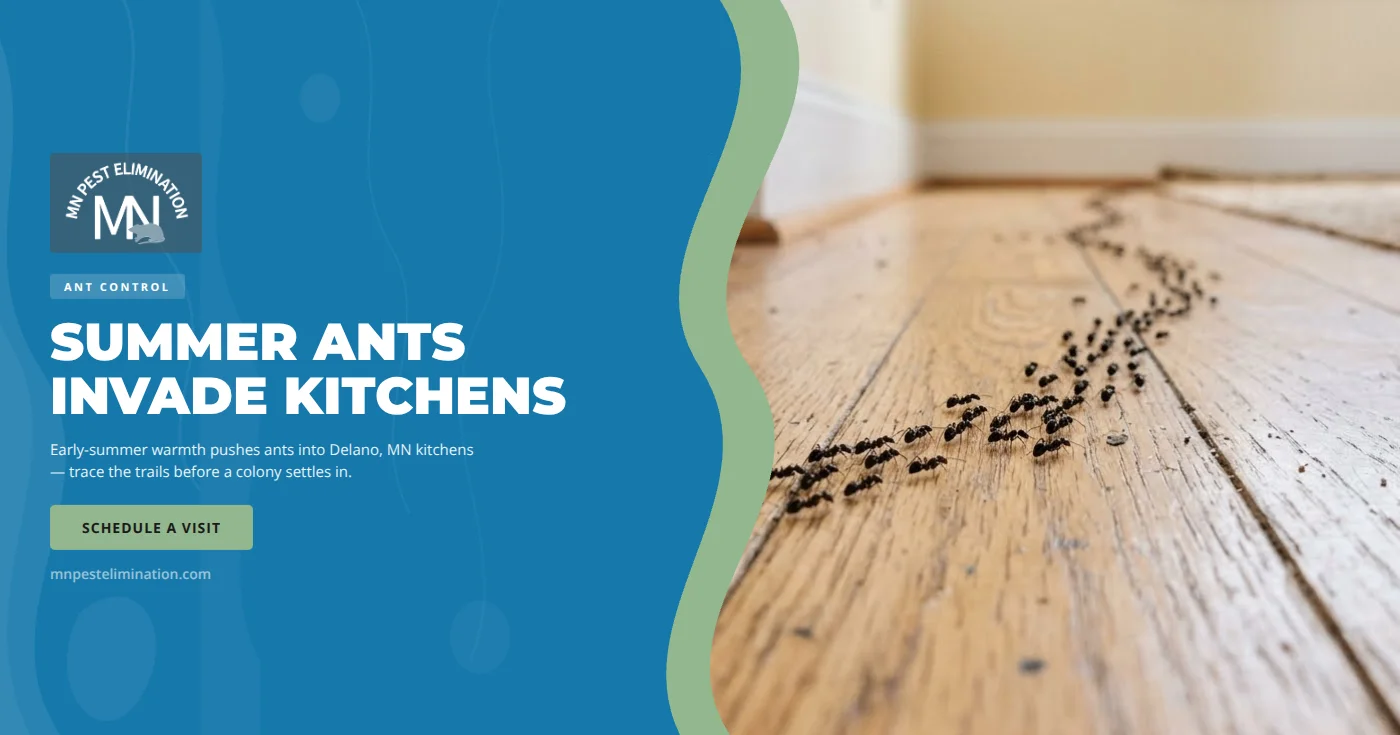
Once the first warm week of June settles into Delano, MN, the call volume for kitchen ant problems jumps almost overnight. Last week the house was quiet; this week there are columns of small brown ants tracking from the dishwasher across the floor, or a few of the much-larger black ones drifting across the countertop at dusk. Homeowners searching for ant control Delano MN homeowners can rely on want one answer — why now, and how do we get them out? Early-summer warmth flips a switch on every common ant species in Wright County, and your kitchen is the resource they were already foraging toward.
At MN Pest Elimination, we work ant calls across Delano and the surrounding Wright County area through the entire June-to-September window, and the pattern is consistent. The three species behind most kitchen and pantry invasions — pavement ants, carpenter ants, and odorous house ants — all expand their foraging range once daytime temperatures hold consistently in the 70s. This guide walks Delano homeowners through why the indoor surge happens when it does, how to tell the species apart, why DIY sprays often backfire, and the practical steps that keep ants out of the kitchen for the rest of summer.
Most homeowners assume a June ant problem is brand new — that a colony just showed up. The reality is the opposite. The colonies producing your kitchen sightings have been on the property all year, nesting in driveway cracks, under landscape stones, in soil along the foundation, or in moisture-damaged wood on the structure. June is simply the month their foraging range expands enough to find your kitchen.
Three things shift at once. Soil temperatures finally hold high enough for full colony activity — pavement ants and odorous house ants forage actively once average soil temperatures climb past about 55°F, a threshold Wright County typically crosses in late May. Colony populations have grown through spring, so the workforce is larger and pushing farther from the nest. And the outdoor food sources that fed colonies through May — flowering plants, aphid honeydew, soft-bodied insects in the yard — dry out as summer heat builds, making indoor crumbs, sticky countertops, pet food, and pantry sweets more attractive by comparison.
Getting the species right matters because the treatment approach changes with each one. According to University of Minnesota Extension, three species drive nearly every indoor ant call in central Minnesota.
Pavement ants (Tetramorium immigrans) are the small dark-brown to black ants — about 1/8 inch long — that most Delano homeowners see first. Colonies nest in soil under sidewalks, driveways, patios, and slab foundations, then enter through concrete cracks and slab edges. They eat almost anything: meats, sweets, grease, pet food, and bread crumbs.
Carpenter ants (Camponotus spp.) are the largest ants you'll see indoors — 3/8 to 1/2 inch long, black or black-and-red, with a single waist node and a smoothly rounded thorax in profile. They don't eat wood; they hollow it out for nesting galleries. Parent colonies need moist or decayed wood, while satellite colonies sit in drier wall voids or attic insulation. Twenty-plus workers indoors on a regular basis, sawdust-like frass piles at baseboards, or winged ants emerging in late spring all signal an established colony.
Odorous house ants (Tapinoma sessile) are the very small brown ants — about 1/10 inch — that walk in tight, fast trails along countertops and baseboards. The diagnostic check is to crush a few: UMN Extension describes the smell as rotten coconuts or blue cheese. They prefer sweets but also feed on meat and grease, and they nest in wall voids, under siding, in landscape mulch, and anywhere with steady moisture.
Ant foraging looks random until you understand it. A scout leaves the colony alone, finds a food source, then returns to the nest laying a pheromone trail the rest of the colony follows. The visible river of ants on your kitchen floor is the trail to a resource a scout located hours or days earlier — which is why a clean countertop doesn't make the problem go away on its own.
The food sources pulling scouts indoors are smaller than most homeowners realize — coffee grounds shaken loose from a pod, syrup residue around a jar lid, pet food left out overnight, crumbs under the toaster, a teaspoon of honey wiped onto the counter. Sweet attractants pull odorous house ants and pavement ants; greasy food and protein scraps recruit pavement ants and carpenter ant foragers. Moisture is the other half — damp areas under the sink, condensation around dishwasher seals, and basement humidity all signal habitable conditions. Most entry points we find on Delano service calls are smaller than a pencil tip: gaps around plumbing penetrations, slab-floor expansion cracks, worn weatherstripping at exterior doors, gaps where siding meets the foundation, and unsealed openings around dryer vents and AC line sets.
Once you know what to look for, ant trails follow predictable routes through Wright County homes. We see the same patterns on nearly every Delano property we walk:
Walking your kitchen and basement with a flashlight at dusk — when foraging activity peaks for most species — surfaces trails that are easy to miss during the day.
The instinct when ants appear is to grab a can of contact spray and hit the visible trail. That action almost always sets the treatment back. Contact sprays kill foragers on the surface, but those workers are 1 to 5 percent of the colony. The queen, brood, and bulk of the workforce stay inside the nest, and killing foragers without reaching the colony just opens space for the next shift to fill in.
For some species, sprays make things measurably worse. Odorous house ant colonies respond to chemical disturbance by "budding" — splitting into multiple satellite colonies that move into new wall voids, multiplying the problem instead of resolving it. Spraying along baseboards also repels foragers that would otherwise carry a slow-acting bait back to the queen. The effective approach is the opposite of intuition: identify the species, locate the nest or the outdoor origin of the trail, then place targeted, slow-acting baits the workers carry back to the colony. Integrated pest management — the framework recommended by the U.S. Environmental Protection Agency and UMN Extension — focuses on source reduction, exclusion, and species-matched treatment rather than visible kill.
Most of the work of keeping ants out of a Delano kitchen is work every homeowner can do without any product. Here's what we walk through on the prevention side of every inspection:
These steps cut indoor activity dramatically, but they don't address an established colony already nesting in a wall void or under the slab. That's where targeted treatment changes the picture.
One scout ant on the counter doesn't need a service call. The thresholds for professional treatment are different: persistent trails that return within days of cleaning, ants in multiple rooms, regular sightings of large carpenter ant workers, frass piles at baseboards, or winged ants emerging indoors.
Our Ant Pest Control service for Delano homes starts with a property inspection — interior trails, foundation perimeter, garage, and outbuildings — to identify the species and locate the active nest or its outdoor origin. Treatment is matched to the species: slow-acting baits for sweet-feeding odorous house ants, targeted gel and granular bait for pavement ants under slabs, and a separate protocol for carpenter ants that combines satellite-nest treatment with parent-colony work and moisture remediation guidance. We pair the first visit with recurring service through the active season, and we serve Delano and the surrounding Wright County area — Waverly, Montrose, Buffalo, Howard Lake, Hanover, Rockford, Annandale, and Clearwater.
Are the ants in my Delano kitchen dangerous to my family?
The common Minnesota kitchen species — pavement ants, odorous house ants, and most carpenter ants — don't bite aggressively or transmit disease the way some tropical species can. The bigger concern with carpenter ants is structural: a colony in a sill plate or wall void excavates wood over time and can produce real repair costs if it isn't addressed.
Why do the ants keep coming back after I spray?
Contact sprays only kill the visible foragers, which are a small fraction of the colony. The queen and brood stay inside the nest and replace lost workers within days. For some species, sprays trigger colony budding and make the indoor population worse.
Can a carpenter ant colony grow inside my walls without me seeing it?
Yes — and that's why early identification matters. Parent colonies live in moist or decayed wood hidden behind drywall, siding, or insulation. Frass piles, hollow-sounding wood, and consistent worker activity are the surface signs of activity going on underneath.
How long does professional ant control take to work?
Bait-based treatments typically show measurable indoor reduction within 7 to 14 days as workers carry the active ingredient back to the colony. Full colony elimination usually takes two to four weeks depending on species and colony size.
June through August is the window when ant problems compound in Wright County kitchens. The earlier in the season the species is identified and the colony located, the easier the problem is to put behind you. If you'd like a property assessment tailored to your Delano home, contact MN Pest Elimination today. We'll walk the property, identify what's established, and build a service plan that gets ants out of the kitchen and keeps them out through the season.