Licensed and Insured. Holding permits through the MN DNR

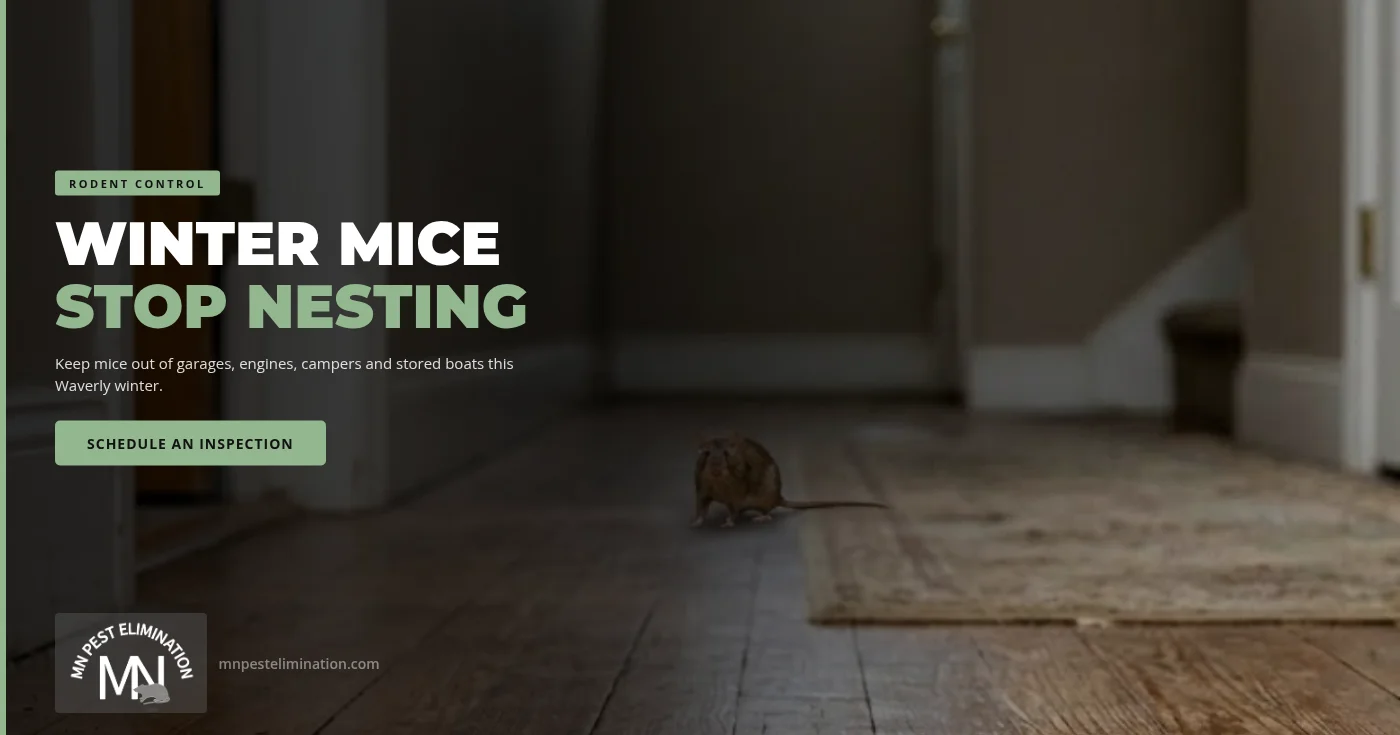
The fields are bare, the first lasting snow is on the way, and suddenly there’s a chewed-open bag of birdseed on the garage floor. If you’ve found mice in garage corners, under the hood of your truck or inside a shrink-wrapped boat this time of year, you’re not alone. Around Waverly, November is when field mice go looking for winter shelter, and garages, pole barns and stored campers are often their first stop.
A few droppings can seem like a minor annoyance. But a mouse that moves in now has four or five quiet months to nest, breed and chew through wiring, insulation and upholstery before anyone notices. Here at MN Pest Elimination, we handle rodent control for homes and outbuildings, and late fall is when our phones get busy for exactly this reason.
In this post, we’ll explain why mice head indoors in November, how they get into attached garages and outbuildings, the warning signs in cars, campers and boats, what the damage can cost, and the practical steps that help. We’ll also cover when professional rodent exclusion makes sense and answer the questions we hear most often.
Mice don’t hibernate. To survive a Minnesota winter they need warmth, food and a protected place to nest. Once the corn and soybeans come off the fields across Wright County, the deer mice and white-footed mice that spent summer outdoors lose most of their cover almost overnight. With highs sliding into the 30s and lows dipping into the 20s, they start moving toward the nearest structure that smells like shelter.
A garage checks every box. It’s out of the wind, a few degrees warmer than outside, rarely disturbed for long stretches and usually full of nesting material: cardboard boxes, old rags, patio cushions and loose insulation. Many garages also hold food that owners don’t think of as food, including bird seed, dog food, grass seed and the bags of corn many families keep for deer feeders.
Timing matters, too. November is when most of us winterize the boat, park the camper and tuck lawn equipment away. Those vehicles then sit untouched for four to six months, giving mice an enclosed, undisturbed space to raise a family. And mice reproduce quickly. According to University of Minnesota Extension and similar sources, a single female can have several litters a year, and young mice may be ready to breed at around six weeks old. A couple of mice in October can become a real population by March, which is why winter mouse prevention works best when it starts early.
Most homeowners are surprised by how little room a mouse needs. A house mouse can squeeze through a gap of roughly a quarter inch, about the width of a pencil. If its head fits, the rest of the body follows.
The most common entry point is the bottom of the overhead door. Rubber seals stiffen and crack in the cold, and the corners where the seal meets the door track rarely close tightly. Concrete slabs also settle and shift with frost, opening gaps along the threshold that grow a little each year. If you’ve ever wondered how mice get into an attached garage in November, that bottom corner is usually the answer.
Other weak spots include gaps around utility lines, dryer and bath vents that exit through the garage wall, and worn weatherstripping on the side service door. Once inside, mice look for the next step: the door between the garage and the house, or the spot where the garage ceiling meets the attic.
Detached buildings are even easier targets. Pole barns often have gaps where steel siding meets the base trim, open soffits and sliding doors that never fully seal. Sheds set on gravel or wood skids leave an open space underneath that’s perfect for burrowing. On rural-residential properties around Waverly, those outbuildings often sit right next to open fields, so they’re the first warm structure a displaced mouse finds.
Mice are quiet and mostly active at night, so the evidence usually shows up before you ever see one. Here are the signs mice are nesting in your car engine or stored vehicle:
Campers and RVs have dozens of openings mice can use: around plumbing and propane lines, slide-out seals, storage bays and wheel wells. Inside, check under cushions, in cabinets and around the furnace. Shrink-wrapped boats look sealed, but vent openings and gaps where the wrap meets the trailer let mice in. Look in the console, under seat cushions and in every storage compartment. If you can, check stored vehicles once a month through winter rather than waiting until spring.
Mice have to gnaw constantly to keep their teeth worn down, and wire insulation, foam and fabric are easy targets. The damage adds up quickly.
Mice in car engine bays tend to chew wiring harnesses, sensor connectors and vacuum lines. Some carmakers use soy-based wire insulation, and owners have alleged that it attracts rodents. That claim hasn’t been proven, but chewed wiring itself is a well-known winter problem, and yes, mouse damage to car wiring happens most often in winter when vehicles sit. Repair estimates are commonly reported anywhere from a few hundred dollars for a single connector to several thousand when a full harness needs replacing; a local auto shop can give you a better picture for your vehicle. Comprehensive coverage sometimes pays for rodent damage, but policies vary widely, so check yours before you need it.
In campers and boats, mice ruin cushions, mattresses and curtains, chew wiring and leave urine stains and odors that are hard to remove. In garages and attics, they tunnel through and soil insulation, which reduces its effectiveness and may mean replacement.
There’s a health side, too. Deer mice, common in rural Minnesota, can carry hantavirus, and closed-up campers and pole barns are exactly where droppings pile up. The CDC’s hantavirus prevention guidance recommends airing the space out for about 30 minutes, wearing gloves, soaking droppings with a bleach solution (roughly one part bleach to ten parts water) for about five minutes, and wiping up with paper towels. Don’t sweep or vacuum droppings, because that can stir contaminated dust into the air.
Mouse-proofing a garage starts at the bottom of the overhead door. Replace cracked or stiff seals and add rodent-resistant corner seals where the door meets the track. Pack small holes around pipes and wires tightly with steel wool, then seal with caulk; use hardware cloth, metal flashing or cement for larger openings. Avoid relying on foam, rubber or plastic alone, since mice chew right through them. Add a door sweep to the service door and to the door leading into the house.
Drive vehicles regularly when you can, and pop the hood on cars that sit for long stretches, since mice prefer dark, undisturbed spaces. Before storing a camper or boat, remove all food, bedding and paper products, close openings around lines and vents with steel wool or mesh, and set snap traps inside along the walls. If you cover air intakes or exhaust openings, hang a bright reminder on the steering wheel so you remove the covers before starting the engine.
What about peppermint oil, dryer sheets or ultrasonic devices? There’s little evidence that any of them keep mice out long term. They won’t close a quarter-inch gap.
DIY steps help, but the most important entry points are often hidden behind shelving, up in the rafters or under siding trim. That’s where professional rodent control Waverly MN homeowners can count on makes the difference.
Here at MN Pest Elimination, we start with a thorough inspection of your garage, outbuildings and the connection points to your home. We look for active runways, nesting sites and every gap a mouse could use. Then we combine rodent exclusion, sealing openings with durable, chew-resistant materials through our exclusion services, with targeted trapping and monitoring placed where pets and kids can’t reach. We don’t recommend scattering loose poison bait in a garage, where pets and wildlife can find it, and mothballs are a regulated pesticide that shouldn’t be used off-label.
If mice have already reached the attic above your garage, our attic insulation & cleanup service removes contaminated material and restores proper insulation. For ongoing peace of mind, we also offer mouse monitoring visits through the cold months.
Because we’re a one-stop shop, the same team that seals your garage can also handle winter wildlife like squirrels. And if you sign up for service, we take the inspection fee off your service, with no cancellation fee.
It helps. Mice prefer engines that stay cold and quiet, so daily driving makes your car less attractive. It isn’t a guarantee, though, especially if the garage itself has easy entry points and a food source.
They often try. An attached garage puts mice right next to your living space, and gaps around the house door, pipes and the attic connection give them a path inside. Sealing the garage protects the whole home.
Keep them closed. Open doors and hatches simply invite mice in. Instead, seal openings around lines and vents, remove food and bedding, and set traps inside.
Ideally in September or October, before the November push. That said, it’s never too late; sealing and trapping now still stops a small problem from growing by spring.
Mice in garage spaces, engines, campers and stored boats are a seasonal reality here, but they don’t have to cost you a wiring repair or a ruined set of cushions. A few sealed gaps, smarter storage and a professional inspection can keep your vehicles and outbuildings protected until spring.
MN Pest Elimination is a locally based team, established in 2025, serving homeowners and businesses in Waverly. We’d love to help you get ahead of winter. Contact us today to schedule your inspection.
When mice move into your garage, pole barn or stored vehicles, we’re ready to help. At MN Pest Elimination, we’re a one-stop shop for pests and wildlife, so you don’t have to juggle different companies for mice, squirrels, bats or attic cleanup. We handle it all with one team.
Our rodent control service is built around finding and fixing the reasons mice got in, not just catching the ones you’ve already seen. Here’s what we bring to every visit:
We also make getting started easy. If you sign up for service, we take the inspection fee off your service, and we never charge a cancellation fee. Know a neighbor dealing with the same problem? Our referral program gives you $20 off service when someone you refer signs up.
Winter is a long season for a mouse tucked into your camper or engine bay. Let us help you shut the door on them now, before chewed wiring and soiled cushions turn into spring repair bills. Reach out to our team to schedule your inspection today.