Licensed and Insured. Holding permits through the MN DNR
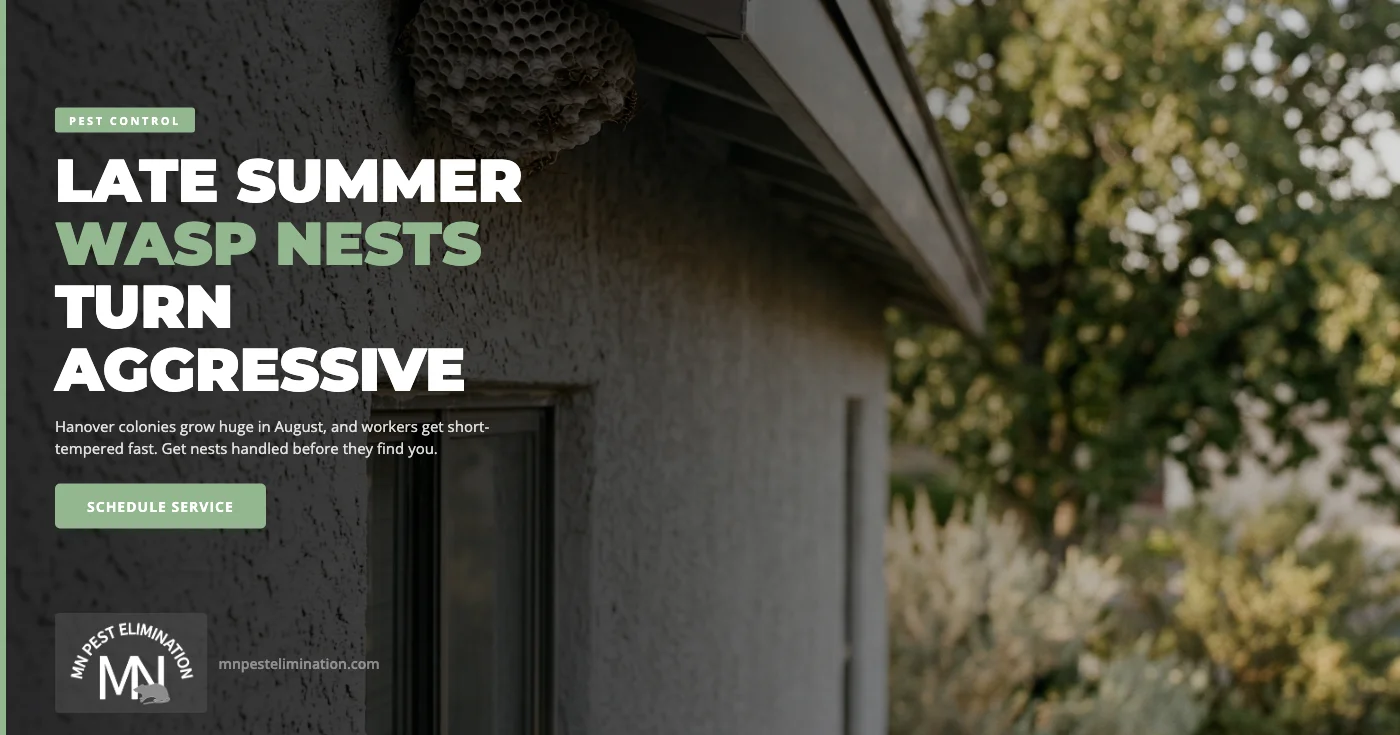
By early July around Hanover, the wasp calls change tone. What was a queen sighting or a quiet paper-wasp nest under a porch railing in May has grown into a football-sized paper wasp comb, a bald-faced hornet nest hanging off a maple branch, or a yellowjacket colony pouring out of a hole in the yard. The insects themselves are also different — larger colonies, more workers on patrol, and a much shorter fuse when something disturbs the nest. This is when wasp control Hanover MN homeowners call about most, and for good reason. Here is what is happening inside those colonies right now and how we approach late-summer nests on Hanover properties along the Crow River, out toward Rockford, and across the Wright County line.
Wasp and yellowjacket colonies in Minnesota follow a predictable annual cycle, and July is the point on that cycle where the population curve turns sharply upward. Every nest you see now was started in April or early May by a single overwintered queen. She built a small starter comb of a dozen cells, raised the first generation of workers herself, and then handed off all foraging and nest expansion to those workers. From there, the colony grows exponentially through May, June, and early July.
By the first week of July, a paper wasp nest that was the size of a golf ball in May is often the size of a saucer with 100 to 200 workers. A yellowjacket colony that started with a queen and a dozen cells in a rodent burrow can hit 1,500 to 3,000 workers by late July. Bald-faced hornet nests that were tennis-ball-sized in early June are now the size of a basketball or larger. The University of Minnesota Extension tracks this population curve every year, and the pattern is consistent — late July through mid-August is when Minnesota colonies reach their maximum size and when human encounters spike.
Hanover sits in a landscape that favors this build-up. The Crow River corridor, the wooded lots along the river bluff, the parks and playgrounds, and the mix of older homes with wood siding and newer builds with vented soffits all provide the exact conditions wasps look for — protected nest sites, plenty of insect prey through midsummer, and shortening nights that push the colony to complete its reproductive cycle before frost.
The dangerous shift in July and August is not just that there are more wasps — it is that the wasps themselves become more aggressive. Three biology-driven changes drive that shift, and understanding them is the difference between a quiet backyard barbecue and an emergency room visit.
The first shift is defensive behavior. A May paper wasp colony with a queen and eight workers cannot afford to lose defenders — the whole colony is fragile. A July colony with 200 workers can spare a defensive swarm without threatening survival. The result is that colonies that tolerated a lawn mower ten feet away in June will send an active response wave at anything within twenty or thirty feet by late July. Yellowjacket colonies in the ground are the most defensive of all — vibrations from a mower, string trimmer, or even heavy foot traffic can trigger a full-scale response.
The second shift is dietary. Through the spring and early summer, worker wasps hunt insect prey — caterpillars, flies, spiders, mosquitoes — to feed the developing larvae back at the nest. In exchange, the larvae secrete a sugary liquid the workers drink. Late in the season, the queen stops laying worker eggs and the brood shrinks. The workers lose their sugar supply and start actively foraging for it on their own. That is exactly when yellowjackets start dive-bombing soda cans, garbage bins, hummingbird feeders, and open food at outdoor picnics. Around Hanover, the timing lines up with fair weather weekends and outdoor family gatherings — the worst possible overlap.
The third shift is directional. Once colonies stop producing workers and start producing next year's queens and males, the whole colony becomes agitated. Any disturbance is met with a much larger, faster, and more sustained response than the same colony would have delivered a month earlier. This is why the "nest we walked past all summer" suddenly stings the neighbor on August 5th.
Three different stinging insects show up on Hanover properties every summer, and they behave very differently. Correctly identifying which one is on your property changes the whole approach.
Yellowjackets are the shorter, stockier wasps with bold yellow-and-black banding across the abdomen. Around Hanover, the two most common species are the eastern yellowjacket and the German yellowjacket. Eastern yellowjackets nest almost exclusively in the ground — old rodent burrows, gaps in retaining walls, spaces under decks and sheds. German yellowjackets are the ones that nest in wall voids, attic spaces, and soffit cavities on houses. Both are the most aggressive of the three groups and account for the vast majority of late-summer stings we treat around Wright County. A single yellowjacket can sting repeatedly and does not lose the stinger.
Paper wasps are the longer, slimmer wasps with dangling legs in flight and umbrella-shaped, open-celled paper nests hanging from a single stalk. Around Hanover you will see two — the native northern paper wasp and the introduced European paper wasp, which has become extremely common in Minnesota over the last two decades. Paper wasps build their comb under eaves, in porch corners, inside grill covers, under playground equipment, and in patio umbrellas that have been closed for a few weeks. They are less aggressive than yellowjackets but will absolutely defend the nest, and their sting is on par pain-wise.
Bald-faced hornets are not true hornets biologically — they are technically a large aerial yellowjacket. They are unmistakable, though: matte black body with a bright white face and white markings on the abdomen, and their nest is the classic gray, papery, football-shaped enclosed structure hanging from a tree branch, high on a house wall, or off a shed. A mature bald-faced hornet nest can hold 400 to 700 workers by August and is the most dangerous of the three to disturb because the colony is enclosed and defends aggressively in every direction at once.
Where you find a nest tells you a lot about which species you are dealing with and how urgent removal is. Around Hanover, the same nest locations come up every July inspection:
When we walk a Hanover property in July, we check every one of these zones. Missing one active nest means the homeowner is back on the phone in two weeks with the same problem.
You do not always see the nest before you see the wasps. On many Hanover properties, the first sign of trouble is behavioral, not visual. Watch for these patterns:
Any one of these signals warrants a careful look. Two or more together means the colony is mature, and the window for handling it without incident is closing.
We understand the temptation. A big-box hardware store sells a $6 can of aerosol wasp spray with a fifteen-foot stream, and it feels like a solvable Saturday-afternoon problem. In May, with a golf-ball nest and a handful of workers, it often is. In late July or August, on a mature colony, it is a real risk.
The colony you are treating in late July is ten to a hundred times the size it was in May. A single can rarely delivers enough active ingredient to reach the deep interior of a paper wasp nest, and it is essentially useless against a ground yellowjacket colony where the visible hole is only the entrance to a football-sized nest chamber two feet down. What you accomplish is stunning the outer defenders while leaving the queen and the majority of the workforce intact — and now agitated. The colony rebuilds defenders within days, but they are now on high alert against the person who tried to spray it.
Bald-faced hornet nests are worse. A homeowner spraying a mature aerial nest from below sends a stream up into a nest that responds by pouring workers out in all directions at once. We have handled two cases in Wright County in the last three summers where a homeowner ended up in the emergency room after attempting a mature bald-faced hornet nest with a store-bought can.
Wall-void nests are the highest-risk category of all. Spraying into the visible entrance of a German yellowjacket nest inside a wall pushes the surviving workers into the interior of the house — sometimes through outlet penetrations, sometimes through recessed light housings, sometimes through a soffit gap into an attic that connects to the living space. We have removed dead-yellowjacket piles from homeowner attics after well-intentioned DIY attempts that turned an outdoor problem into an indoor one.
The other quiet risk is allergy. Roughly three percent of the population has an allergic response to hymenoptera venom, and roughly 0.5 to 1 percent has a serious systemic reaction. Most people who discover they are allergic do so during a sting incident. A DIY attempt on a mature colony is exactly the scenario where that discovery becomes an emergency.
Our approach to late-summer wasp calls in Hanover is built around the biology of the colony — not just knocking down what is visible, but resolving the nest so it does not rebuild and the workers do not disperse into the house.
Every job starts with identification. We confirm which species is on the property, where the nest is located, how mature the colony is, and whether there are secondary or satellite nests we need to account for. On a typical Hanover property in July we often find two or three separate nests — a paper wasp comb under an eave, a yellowjacket hole in the lawn, and sometimes a bald-faced hornet nest we spot on the walk-around that the homeowner had not noticed.
Treatment is species-specific. Ground yellowjacket nests get a targeted dust application at the entrance that workers track back into the colony chamber over 24 to 48 hours, reaching the queen and the brood without the drama of spraying. Paper wasp combs are treated directly and, once dormant, physically removed so the nest cannot be reoccupied. Bald-faced hornet nests are handled at dawn or dusk when the colony is inside and treated with a residual product before removal. Wall-void nests get a targeted injection at the entrance combined with sealing of any interior escape routes to prevent workers from entering the living space.
Every treatment we apply is chosen with pets and families in mind and applied at rates and locations well within Minnesota Department of Agriculture guidelines. For Hanover homeowners who deal with wasps every summer — and along the Crow River corridor, that is most homeowners — we offer a seasonal program under our Residential Pest Control plan that includes proactive spring queen suppression, a midsummer inspection sweep, and a fall check to catch late-season colonies before they overwinter queens for next year.
Two reasons. First, colonies reach peak size in July and August — a yellowjacket nest can grow from a queen and a dozen cells in May to 1,500 to 3,000 workers by late summer. A larger colony can afford a bigger defensive response. Second, the workers' food source shifts. Once the queen stops laying worker eggs, the brood shrinks, and the workers lose the sugary secretion the larvae normally provide. They start actively hunting sugars in the environment — picnics, sodas, garbage — which brings them into direct contact with people just as they are also more defensive of the nest. UMN Extension tracks this predictable July-August aggression spike every year.
The right approach depends entirely on species, location, and colony size. A small early-season paper wasp comb in a visible location can sometimes be handled by a homeowner with proper protection and a well-timed application at dusk. A mature late-summer nest — especially a ground yellowjacket, a wall-void colony, or a bald-faced hornet — is a call for a professional. The single biggest mistake we see on Hanover properties is spraying a mature nest with a store-bought aerosol and then having the surviving colony either relocate deeper into a wall or launch an aggressive defensive response for days afterward. Correct identification and species-specific treatment is what actually resolves the nest.
The best window is late May through early June, when queens are establishing new nests and the colonies are small. A single dust or residual treatment at that stage neutralizes a nest that would have grown to 200 to 2,000 workers by August. Once you are into July and August, treatment is still very effective but the colony is larger, more defensive, and more physically imposing to work with. If you missed the spring window, do not wait — a mature colony in late summer will still be active into October in most Minnesota years, so treatment now protects the rest of the season and reduces overwintering queen numbers next spring.
They are one of the most defensive stinging insects in Minnesota, and yes, a mature nest is genuinely dangerous to disturb. Bald-faced hornets can sting repeatedly, and they respond to a threat with a coordinated colony-wide defensive response rather than a few individual workers. A mature aerial nest in August can hold 400 to 700 hornets, and a disturbance will produce a defensive wave in all directions at once. If you see the classic gray papery football-shaped nest anywhere on a Hanover property — in a tree, on a house wall, off a shed — do not attempt it yourself. Call for a professional evaluation.
Late July through early September is the window when Hanover wasp problems go from a minor annoyance to a real hazard. Colonies are at peak size, workers are on edge, and the sugar-foraging shift puts yellowjackets in the middle of every backyard gathering. Handling nests now — while the season still has weeks of activity left — is what keeps the rest of your summer usable and your fall yard work uneventful.
If you are hearing scratching inside a wall, watching wasp traffic to the same corner of the soffit, or spotting a ground hole with yellowjackets streaming in and out, reach out to MN Pest Elimination. We handle wasp, yellowjacket, and bald-faced hornet nests across Hanover, Rockford, Buffalo, Delano, Waverly, Montrose, Howard Lake, Annandale, and the surrounding Wright County service area, with treatment strategies matched to species and colony stage. Peace of mind before the next family gathering is one call away.