Licensed and Insured. Holding permits through the MN DNR
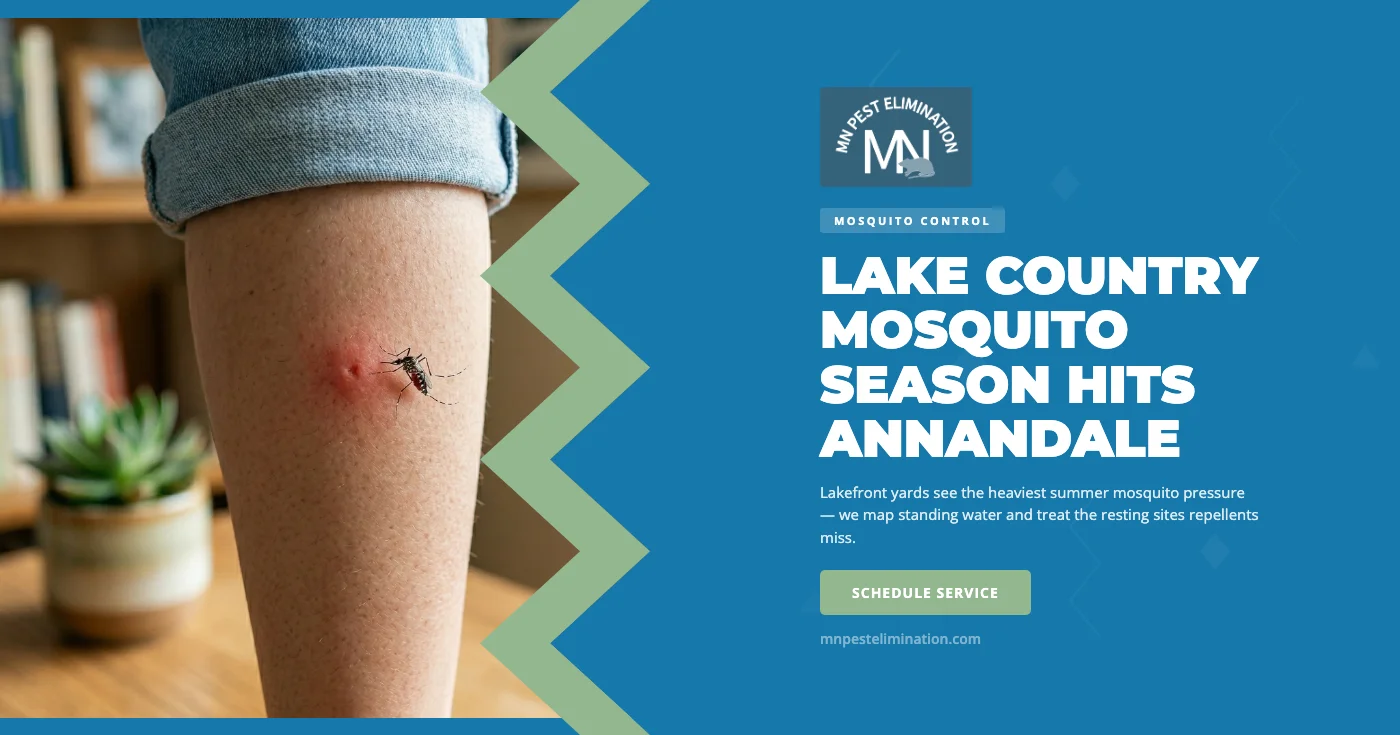
Step out onto a dock on Pleasant Lake at dusk in late June, listen to the loons, and you will hear something else too — the high whine of mosquitoes drifting in off the cattails. For homeowners in Annandale, MN, that sound is the soundtrack of summer, and it gets louder the closer your yard sits to water. We have spent years working lakefront properties across Wright County, and we can tell you the pressure here is not in your head — it is a measurable, predictable consequence of geography, snowmelt, and wetland edge.
This post breaks down why Annandale lakefront yards take the heaviest hit during mosquito season, where the breeding hotspots actually are on your property, and what an effective program looks like. If you are already past the research stage and just want professional help, our mosquito control annandale mn service is built specifically for lake country conditions. For everyone else, read on — we will walk through the biology, the habits, and the treatment approach so you can make an informed decision before the next hatch hits Annandale.
Annandale sits inside one of the densest concentrations of small lakes in central Minnesota. Pleasant Lake, Clearwater Lake, Cedar Lake, Lake John, and Lake Mary form a ring of standing water around town, and dozens of smaller wetlands and seasonal ponds fill the spaces in between. Every one of those water bodies is a potential nursery for mosquito larvae, and every shoreline reed bed is a daytime resting spot for adult females looking for a blood meal.
Mosquitoes are weak fliers — the University of Minnesota Extension notes that most nuisance species in our region travel only a few hundred yards from where they emerge, though Aedes vexans, our most common floodwater mosquito, can drift miles on a steady breeze. In Annandale, prevailing west and southwest evening winds push fresh waves of adults inland from lake margins right when families are trying to grill, swim, or sit by a fire. That is why even a yard with no obvious standing water on it can feel overrun the moment the sun drops.
The other factor is humidity. Lakefront air in Annandale holds moisture longer through the night, which extends the active feeding window for adult mosquitoes. A yard a mile inland may cool and dry out by 10 p.m.; a shoreline yard rarely does. That single difference can double or triple the bite count on a still summer evening.
The mosquito season in Annandale technically begins under snow. Spring Aedes mosquitoes — the so-called snow-pool species — lay eggs in late summer that overwinter in dry leaf litter and low-lying ground. When April snowmelt and early rains fill those depressions, the eggs hatch within days. By the time most Annandale homeowners are pulling docks out of storage, the first generation of biting adults is already on the wing.
This is why the worst mosquito years in Wright County are often the ones that follow heavy winters. More snow means more meltwater, which means more temporary pools, which means a bigger first hatch feeding the population for the rest of the season. The U.S. Centers for Disease Control and Prevention identifies this kind of early-season abundance as a key driver of summer mosquito-borne disease risk, because high adult populations in May and June give viruses like West Nile more vectors to amplify in before peak transmission in late summer.
By June, the snow-pool species hand off to summer breeders — Culex tarsalis, Ochlerotatus trivittatus, and Aedes vexans — which use any standing water available. From that point until first frost, the Annandale population is essentially self-renewing as long as we get periodic rain.
When we inspect a lakefront yard in Annandale, we are not looking at the lake itself — fish, dragonfly nymphs, and wave action keep open water relatively unproductive for mosquito larvae. We are looking at the small, still, organic-rich water sources that homeowners walk past every day without noticing.
The University of Minnesota Extension emphasizes source reduction as the single most effective homeowner action, and we agree — but on Annandale lakefront lots, there are simply too many hidden sources to eliminate them all. That is where a treatment program comes in.
We get this question constantly: "Can't we just use bug spray, citronella candles, and a few of those clip-on fans?" For a single evening on a covered porch, sure — those tools have their place. The U.S. Environmental Protection Agency reviews and registers personal repellents like DEET, picaridin, and oil of lemon eucalyptus, and they work well for short outdoor exposures.
The problem in Annandale is duration and area. A citronella candle protects roughly a three-foot bubble in still air, and even that bubble collapses the moment a lake breeze picks up. Personal repellent works on the person wearing it, not on the yard. Neither tool reduces the breeding population, which means tomorrow night you start from zero again. We have walked plenty of Annandale yards where the homeowner had three citronella torches, two bug zappers, and a thermacell on every patio chair, and the bite count was still unmanageable.
An integrated mosquito management approach — the framework recommended by both the EPA and the CDC — combines source reduction, larvicide where standing water cannot be eliminated, and targeted adulticide on resting sites. That is the framework we use, scaled to the specific conditions of an Annandale lakefront lot.
Our Mosquito Control program for Annandale lakefront properties starts with an inspection of the entire lot — not just the yard, but the wooded buffer, the shoreline transition, outbuildings, and any drainage features. We document standing water sources, identify resting vegetation, and build a treatment map specific to your property.
Treatments target adult mosquitoes where they actually spend their day: the undersides of leaves on shrubs and lower tree branches, dense ornamental plantings, the shaded north side of the house, deck skirting, and wood piles. A residual product applied to these resting sites continues working for roughly three weeks, which sets the rhythm for our recurring service. We also place larvicide in any standing water that cannot be drained — corrugated drain outlets, ornamental ponds, low spots — using products with strong environmental track records that target mosquito larvae without harming fish or beneficial insects.
We deliberately avoid blanket fogging of open lawn and shoreline vegetation. It looks impressive, but it kills pollinators and dragonflies that are already eating mosquitoes for us, and the effect dissipates within hours. Targeted treatment of resting sites does more with less product, which matters when your yard sits feet from a Wright County lake.
Most Annandale customers stay on a recurring schedule from mid-May through September. We come back on a roughly three-week cycle, reinspect, retreat resting sites, and refresh any larvicide that has cycled out. The goal is not zero mosquitoes — anyone promising that on a Minnesota lakeshore is selling something. The goal is to drop the population to the point where you actually use your yard again.
Even with professional treatment in place, a few daily habits make a real difference on an Annandale property. These are the ones we coach customers on after every initial inspection:
None of these habits replaces a treatment program, but together they shrink the population pressure inside your property line, which makes our treatments work harder and last longer. The Minnesota Department of Health publishes similar source-reduction guidance as part of its West Nile virus prevention messaging, and we echo it on every initial walkthrough in Annandale.
If you are already swatting through dinner on the deck in early June, you are behind the curve. The most effective Annandale programs start in mid-to-late May, before the summer species fully take over from the snow-pool generation. Starting early means we knock down the breeding population before it compounds, and you spend the rest of the season maintaining a low baseline instead of fighting an established surge.
That said, it is never too late in the season to start. A first treatment in July still produces meaningful relief within a week, and recurring service through Labor Day weekend protects the part of summer most Annandale families care most about — the cabin guests, the graduation parties, the lake afternoons that get cut short by clouds of mosquitoes. Our mosquito control annandale mn service is built around that reality.
We also recommend professional service for any Annandale property with vulnerable household members — young children, older adults, or anyone with a compromised immune system — because of the small but real risk of West Nile virus that the Minnesota Department of Health tracks every summer. Reducing adult mosquito populations on your property reduces exposure, which the CDC consistently identifies as the most effective personal protection layer alongside repellents and screened windows.
How often should mosquito treatment be applied on an Annandale lakefront property?
We treat on a roughly three-week cycle from mid-May through September. Lakefront lots with heavy vegetation or persistent standing water sometimes benefit from a tighter two-week schedule during peak July pressure. We adjust based on what we see during each visit.
Will mosquito treatment harm pollinators or dragonflies around my Annandale yard?
We use targeted application to mosquito resting sites — dense shrubs, lower leaf undersides, deck skirting — rather than blanket fogging of open lawn or flowering plants. This approach minimizes impact on bees, butterflies, and dragonflies, which are doing free mosquito control work we want to preserve.
Can you treat near the shoreline or over water?
We do not apply adulticide directly to open water or shoreline vegetation that sits in the water. For standing water on the property that cannot be drained, we use larvicide products specifically formulated to target mosquito larvae without harming fish or other aquatic life, consistent with EPA guidance on integrated mosquito management.
What is the best mosquito service for Annandale, MN homeowners?
The right service is one built around Minnesota lake-country conditions — snowmelt timing, summer floodwater species, dense shoreline vegetation, and the realities of treating around water bodies. Our Annandale program is designed for exactly that, and we adjust it property by property based on what your specific lot needs.
If you are tired of writing off summer evenings in Annandale, we would like to walk your property and put together a treatment plan that fits your lot and your season. Reach out through our contact page and we will get a first visit scheduled before the next hatch — so the rest of your Annandale summer belongs to you, not the mosquitoes.