Licensed and Insured. Holding permits through the MN DNR
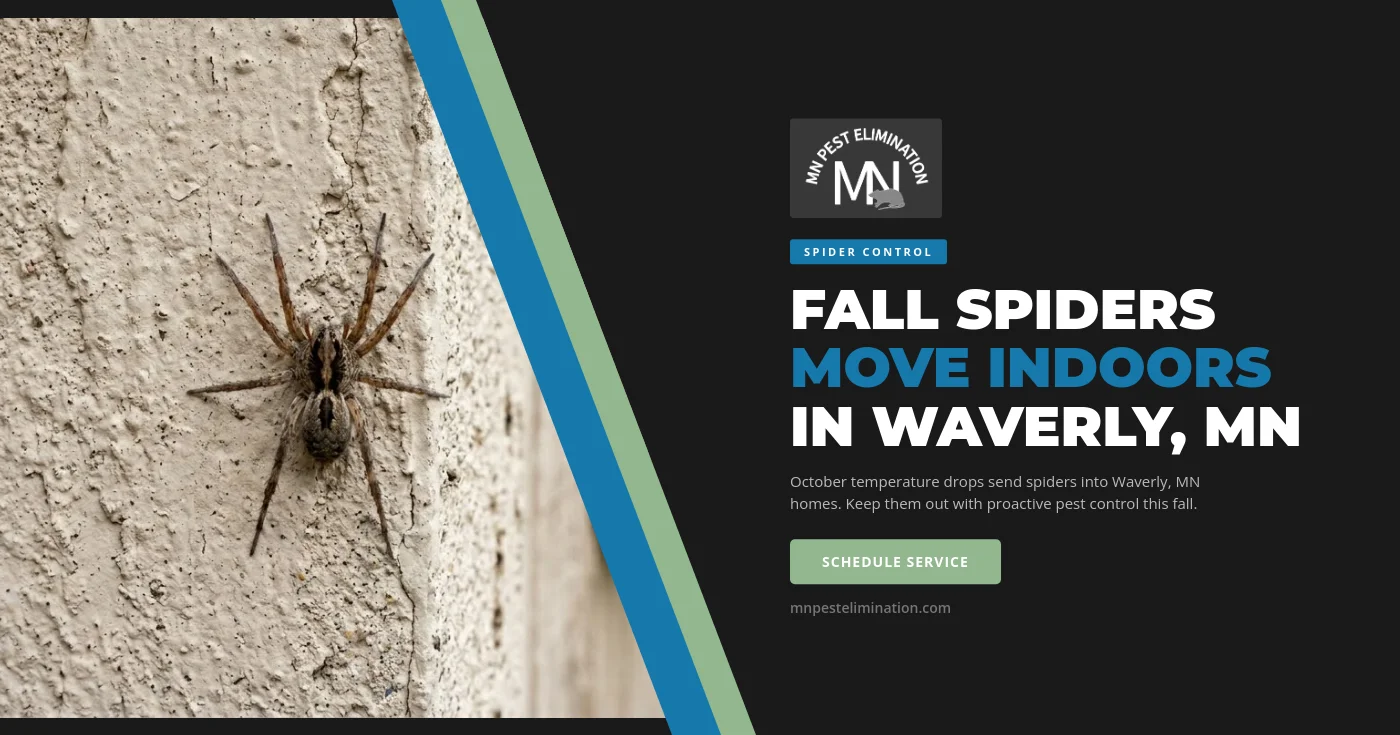
By the first week of October in Waverly, MN, overnight lows have been running in the low 40s and dipping toward the 30s, and the spiders that spent summer under siding, in woodpiles, and in the corners of garden sheds are suddenly very interested in the inside of your house. Most Waverly homeowners notice it the same way every year — a cellar spider dangling from the laundry-room ceiling, a wolf spider sprinting across the hardwood when someone turns a basement light on, a funnel-weaver web covering a window well overnight. Effective spider control Waverly MN homeowners actually benefit from is targeted at this October window — before the population settles into basement sill plates and garage corners for the winter.
Spiders do not migrate indoors because they have planned for winter. They end up inside because their outdoor conditions collapse within a two-to-three-week window every fall, and the warm, humidity-stable interior of a Wright County home is the nearest acceptable habitat. For most of our common Minnesota spiders, that collapse starts when overnight lows drop below about 50°F and accelerates once we see the first run of nights in the 30s — exactly the pattern Waverly sees between late September and mid-October most years.
Two forces drive the push. First, prey: the flies, gnats, mosquitoes, and small moths spiders eat crash in abundance as outdoor temperatures fall. Second, temperature regulation: spiders are cold-blooded, and once outdoor temperatures stay below their activity threshold they cannot hunt efficiently. A heated Waverly home solves both problems — stable 65 to 72°F interior temperatures, a steady supply of indoor insects around windows and lights, and plenty of undisturbed harborage behind storage boxes and in garage corners. The spider control Waverly MN residents actually need targets this October movement window, before the population settles into deep harborage you can no longer reach.
After thousands of fall inspections across Waverly, Montrose, Buffalo, Howard Lake, and the surrounding Wright County area, we see the same handful of species inside Minnesota homes year after year. The University of Minnesota Extension documents the same list in its household insects guide.
Species identification matters because it changes the response. A quiet cellar spider population is self-regulating and reduces with vacuuming; a growing hunting-spider population is a sign of unsealed foundation gaps that need direct exclusion work.
This is the question we are asked more than any other on fall spider calls, and the honest answer is reassuring for Waverly homeowners. The brown recluse has no established population in Minnesota, and the northern black widow, while native, is uncommon and rarely found indoors.
Brown recluse spiders (Loxosceles reclusa). The brown recluse is a southern Midwest species — Missouri, Kansas, Arkansas, parts of southern Iowa. The University of Minnesota and allied entomology sources document fewer than a handful of verified recluse specimens in Minnesota over the past 70 years, and every one arrived in boxes, furniture, or vehicles brought up from farther south. We have never confirmed a brown recluse in a Wright County home.
Northern black widow spiders (Latrodectus variolus). The northern black widow is native to Minnesota but uncommon. It lives mostly outdoors — in woodpiles, under rocks, and in other sheltered, undisturbed spots — and is rarely seen inside homes.
One group worth noting: yellow sac spiders (Cheiracanthium). These pale yellow-green hunting spiders occasionally turn up in Minnesota homes and are the species most commonly associated with the bites people incorrectly attribute to recluses. Yellow sac bites are typically mild — localized redness, sometimes a small welt that resolves in a few days — and nothing like the tissue-damaging bites a brown recluse produces. Most of what Minnesota homeowners describe as "spider bites" are not spider bites at all; they are flea bites, bed bug bites, or other insect reactions.
In practical terms: the spiders coming into Waverly homes this October are nuisance spiders, not dangerous ones. The reason to take fall spider activity seriously is population management and the unpleasantness of a wolf spider on a basement floor at 2 a.m. — not personal risk.
Spiders cluster in a predictable set of harborage zones — undisturbed, humidity-stable, close to small prey, and connected to the outdoors through a gap or crack. On fall spider control Waverly MN calls across Wright County, we see the same locations driving most indoor populations:
The exclusion work that matters most for fall spider control is the same work that reduces mouse and cockroach pressure — targeted sealing of the pathways pests use to cross the thermal envelope. The spider-specific priorities:
Many Waverly homeowners manage fall spider activity with a vacuum, a step stool, a weatherstripping kit, and a tube of silicone caulk. For a cellar spider population in an unfinished basement or a few cobwebs along a porch soffit, that is often sufficient — we would rather you keep money in your pocket than hire us for a problem a weekend of exclusion work resolves.
Professional spider control makes sense when any of the following apply:
Our spider control Waverly MN service starts with a full exterior and interior inspection — foundation walls, window wells, garage corners, basement sill plates, utility rooms, and any outbuildings. We identify the species driving the population, map active entry pathways, and build a treatment plan that combines targeted perimeter application with physical exclusion. For most Waverly homes, two seasonal visits — a fall perimeter and a spring follow-up — reduce indoor spider activity to a level homeowners rarely think about again.
Fall is the loudest spider season, but a year-round approach keeps populations suppressed every month.
Do spider sprays from the hardware store work in a Minnesota basement? Over-the-counter perimeter sprays work on contact and offer brief residual effect, but they rarely address the harborage supporting the population and lose effectiveness quickly on raw concrete. For a cellar spider or two, a vacuum is more effective. For a persistent population, professional application combined with exclusion is more durable.
Will your treatment harm pets or children? Our fall perimeter treatments use low-impact, pet-friendly product classes applied to foundation walls, soffits, and exterior entry points — surfaces family members and pets do not routinely touch. We follow label re-entry intervals strictly on any interior application.
Why do I keep seeing cellar spiders even after I clean? Cellar spiders feed on other spiders and small basement insects. Their presence often signals a secondary pest population — springtails, booklice, or small flies around a water source — that needs addressing first. Eliminate the prey and the cellar spider population declines on its own.
Is seeing one or two spiders a sign of an infestation? No. Minnesota homes routinely host a small background spider population year-round. The threshold for professional spider control in Waverly is persistent visible activity in finished living space, not an occasional sighting in a basement corner.
October is the window in Waverly when fall spider activity peaks and when exclusion work still pays dividends for the entire winter. If you are finding wolf spiders in finished living space, funnel-weaver webs rebuilding within days, or hunting spiders in multiple rooms, reach out to us at MN Pest Elimination for spider control in Waverly. We serve Waverly, Montrose, Delano, Buffalo, Howard Lake, Hanover, Rockford, Annandale, Clearwater, and the surrounding Wright County area, and can usually schedule an inspection within a week. Contact MN Pest Elimination to get on the fall calendar before the first hard freeze locks the indoor population in for the winter.
October is the last practical window in Waverly, MN to address fall spider activity before the first hard freeze locks the indoor population into basement sill plates, garage corners, and cold-air returns for the winter. If you are finding wolf spiders in finished living space, funnel-weaver webs rebuilding on window wells within days, or hunting spiders in multiple rooms, reach out for spider control in Waverly, MN before the fall relocation is complete.
At MN Pest Elimination, we serve Waverly, Montrose, Delano, Buffalo, Howard Lake, Hanover, Rockford, Annandale, Clearwater, and the surrounding Wright County area with a fall spider program built for the mix of older housing stock, lake homes, and newer subdivision construction we work on every week:
The fieldstone foundations, window wells, attached pole barns, and shoulder-season garages across Wright County make October the difference between a quiet winter and a spider population compounding behind your sill plates until spring. Contact MN Pest Elimination today to schedule your fall spider inspection before the first hard freeze.