Licensed and Insured. Holding permits through the MN DNR
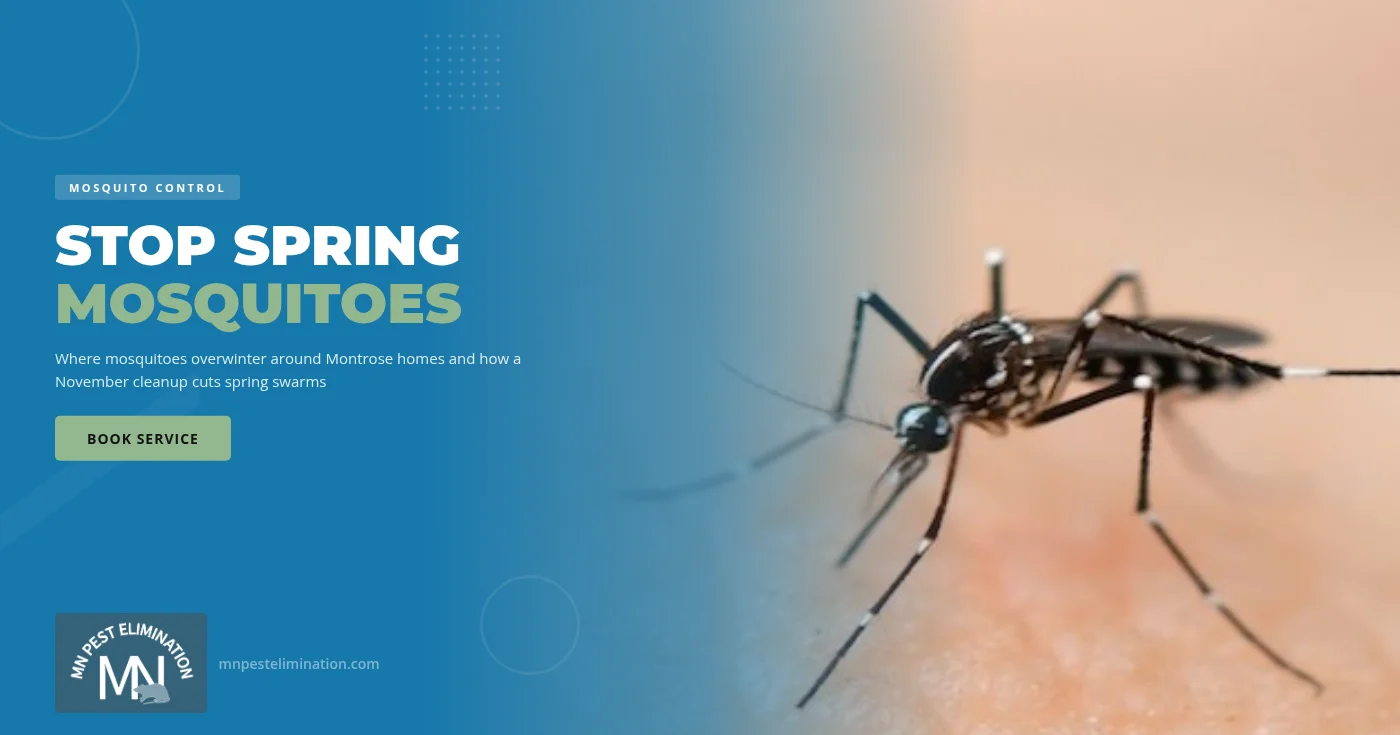
When the first hard frost settles over Wright County, it’s tempting to think mosquito season is over until next summer. The truth is less comforting. Many of the mosquitoes that will bite at your June graduation party are already tucked away in garages, crawlspaces, basement corners and frozen low spots in the yard. That’s why effective mosquito control in Montrose, MN really begins in November, not May.
Here at MN Pest Elimination, we hear the same question every fall: where do mosquitoes go in winter in Minnesota? The short answer is that they don’t go far. Some species spend the cold months as mated adult females hiding in sheltered spaces. Others leave eggs in damp soil, gutters and forgotten buckets, and those eggs hatch once the snow melts.
In this guide, we’ll explain how overwintering mosquitoes survive, where they hide around your home and which eggs make it through the freeze. We’ll also share a practical November cleanup checklist, show you how to seal gaps and help you plan spring treatments before the snowmelt.
Mosquitoes are cold-blooded, so their activity slows to a crawl once nights drop into the 40s and below. By November, the biting has stopped. The population hasn’t vanished, though. It has shifted into survival stages that are built to outlast a Minnesota winter.
Different mosquitoes use different strategies. Based on general mosquito biology and resources like the University of Minnesota Extension, they fall into three main groups:
Hibernating adults don’t bite. They live off fat reserves and stay mostly still until temperatures climb. In spring, those females can emerge early, find a blood meal and lay the season’s first eggs. At the same time, eggs in the soil hatch as snowmelt fills low spots.
That’s the idea behind fall mosquito prevention. Every overwintering female you keep out of the garage, and every egg-coated container you clean, is one less starting point for next year. Fall work won’t eliminate mosquitoes, because nearby wetlands will always produce some. It can still meaningfully reduce what starts right next to your house.
Hibernating mosquitoes look for places that stay above freezing, out of the wind and fairly humid. Around a typical home, there are more of those spots than most people expect.
Attached garages are prime real estate. They’re sheltered, often a little warmer than outdoors, and full of shelving and stored items where a mosquito can sit undisturbed for months. Sheds and pole buildings offer similar cover, especially when they have gaps around the doors or open soffits. If you’ve spotted a sluggish mosquito on the garage wall in December, you’ve likely found an overwintering female.
Crawlspaces may be the most attractive overwintering site around a house because they’re dark, damp and shielded from temperature swings. Unfinished basements, utility rooms and window wells work much the same way. Mosquitoes get in through foundation vents, gaps around pipes, loose access doors and torn screens.
Outdoors, mosquitoes also shelter in culverts, storm drains, hollow logs, animal burrows and brush piles. Wright County’s lakes and wetlands give them plenty of options.
So, do mosquitoes overwinter in garages and basements? Some species do. The upside is that these are also the spaces you can control most directly, by decluttering, sealing entry points and reducing moisture.
Adults are only half the story. Mosquito eggs in winter are remarkably tough, and many species actually depend on a cold period before they hatch.
Floodwater mosquitoes lay their eggs on damp soil in places that will later fill with water. That includes ditches, yard depressions, pond edges and soggy corners of a lot. Some of these eggs reportedly need to dry out and then freeze before they’re ready to hatch. Many can also survive more than one winter. When snowmelt pools in those low spots, a large hatch can follow within days.
Container-breeding mosquitoes lay eggs on the inside walls of anything that holds water. One example is the eastern treehole mosquito, which is found in parts of Minnesota. Common culprits include:
Here’s what many homeowners miss: dumping the water isn’t enough. The eggs stick to the container walls, so you need to scrub them off or store the item upside down or indoors. A bucket emptied in October but left outside can still produce mosquitoes after the first warm spring rain.
November is usually the last practical window before the ground freezes hard. A fall yard cleanup to reduce mosquitoes takes an afternoon or two. Here’s the checklist we recommend:
This standing water cleanup won’t stop mosquitoes coming from a nearby marsh. It does remove the breeding sites closest to where your family spends time, and those tend to matter most.
Once the yard is in order, turn to the house. Keeping mosquitoes out of garages, crawlspaces and basements now means fewer early biters next spring.
Small fixes go a long way: new door sweeps, fine-mesh vent covers and sealant around utility penetrations. Reducing moisture in crawlspaces and basements with better drainage or a dehumidifier also makes those spaces less inviting.
The same openings that let mosquitoes in also invite mice, spiders and other pests looking for winter shelter. That’s why many homeowners pair fall mosquito work with our exclusion services. We inspect the structure and seal entry points with durable materials. If you find a mosquito resting indoors this winter, go ahead and swat or vacuum it, then treat it as a sign that there’s an opening worth tracking down.
Fall prep is half the plan. The other half is timing spring treatments to catch the first generation before it multiplies.
When should you start mosquito treatments in Minnesota? In many years, the first adults become active as days settle into the 50s and snowmelt pools in low ground. That’s often late April or May, but it varies. Here at MN Pest Elimination, we watch local conditions and adjust our timing instead of relying on a fixed calendar date. Starting early knocks back populations before they build.
There’s also a local reason to plan ahead. As we understand it, the Metropolitan Mosquito Control District serves the seven-county metro area. Montrose sits in Wright County, which appears to be outside that district. That likely means homeowners here don’t receive public larval control, so private treatments and your own cleanup carry more weight. We recommend confirming the current boundaries with the district directly.
Planning during the winter has perks:
Mosquitoes are just one of the seasonal pests we handle. You can browse our pest control services to see how one provider can cover insects, rodents and wildlife all year.
Many individual mosquitoes die off in fall, but the species survive. Some spend the winter as hibernating adult females and others as eggs, and both are adapted to Minnesota cold.
Not necessarily. Eggs and hibernating adults are built for freezing temperatures, so a harsh winter may have less effect than people hope. Snowmelt and spring rainfall often play a bigger role.
We think so. Removing containers, cleaning gutters and sealing garages and crawlspaces cuts down on the breeding sites and shelter closest to your home. Combined with spring treatments, it can make a noticeable difference.
Hibernating mosquitoes don’t bite, so they’re more of a clue than a threat. Remove them and look for the gap or torn screen that let them in.
The mosquitoes that will crowd your yard next June are already waiting it out in garages, crawlspaces, gutters and low spots. A November cleanup, a few sealed gaps and a spring treatment plan put you ahead of them. Here at MN Pest Elimination, we’re a local team based in Waverly, established in 2025, and we’re proud to serve neighbors throughout this part of Wright County.
When you’re ready to plan mosquito control in Montrose, MN for next season, contact us to schedule an inspection. We’ll take it from there.
We can. Our team handles fall mosquito prevention and spring treatment planning for homeowners in Montrose and nearby communities. As a one-stop shop, we cover everything from mosquitoes and stinging insects to rodents and wildlife, so you don’t have to juggle several providers.
Here’s how we help you get ahead of next season:
If you sign up after an inspection, we take the inspection fee off your service. We also offer $20 off service when you refer a neighbor who signs up.
We’re based in Waverly and established in 2025, and we bring a straightforward approach to every property we visit. We’d love to help you enjoy a yard with fewer mosquitoes next summer. Reach out to us to get your plan started.