Licensed and Insured. Holding permits through the MN DNR

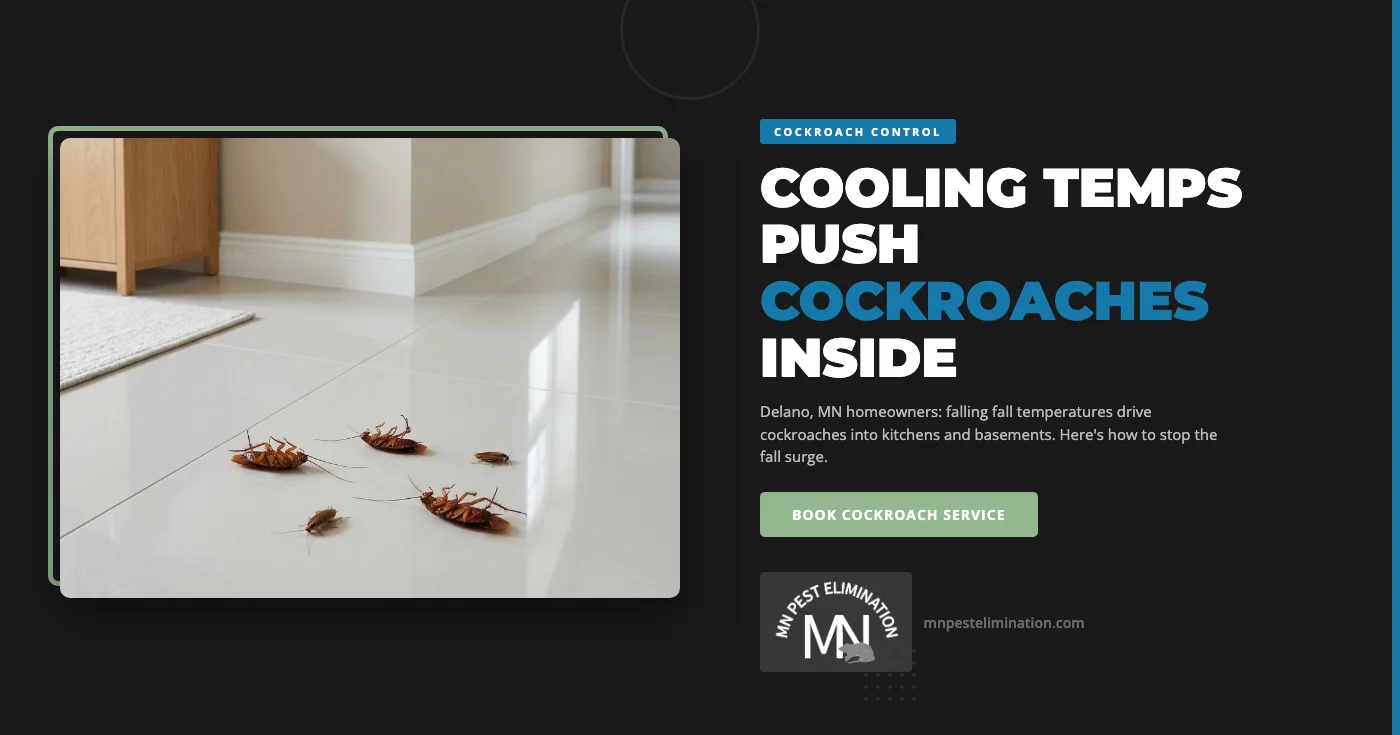
By late September in Delano, MN, overnight lows are running in the 40s, corn along US-12 is drying down toward harvest, and the cockroaches that were content in a garage, dumpster, or crawlspace all summer are actively looking for a warmer place to spend the winter. Most Delano homeowners assume cockroaches are a southern problem — that Minnesota's brutal winters keep them out. The reality is more complicated: our outdoor climate is genuinely hard on cockroaches, but our heated homes are perfect year-round habitat, and fall is when populations move indoors. Effective cockroach control Delano MN homeowners actually get results from starts in September, before the population has settled into a wall void, dishwasher motor housing, or floor drain for the winter.
Cockroaches don't hibernate. When outdoor overnight temperatures in Delano drop below roughly 50°F — which happens most years by the second or third week of September — the species that spent summer outside cannot maintain the body temperature they need to feed and reproduce. Instead of dying off, they migrate. The University of Minnesota Extension identifies four species that regularly show up inside Minnesota homes: German cockroaches (Blattella germanica), the small tan species that dominates kitchens and bathrooms; American cockroaches (Periplaneta americana), the large reddish-brown species that favors basements and sewer connections; Oriental cockroaches (Blatta orientalis), a dark almost-black species partial to cool damp basements; and brown-banded cockroaches (Supella longipalpa), a small species that prefers warmer, drier upper-level rooms.
Each species has a different fall-entry pattern, but all four end up in Delano homes for the same reason — a heated Wright County house is ideal habitat once outdoor conditions collapse. Cockroach control Delano MN homeowners really need is aimed at this fall movement window — once temperatures drop past 50°F for three or four consecutive nights, the interior push accelerates rapidly.
Every cockroach infestation in a Delano home starts with a specific entry pathway. The routes we see repeatedly on cockroach control calls across Wright County are boringly predictable, which is good news — most of them are fixable before the first hard freeze.
Cockroaches are nocturnal and secretive, so a fall infestation in a Delano home usually reveals itself through indirect signs long before a homeowner sees a live insect. A ten-minute inspection of the low-traffic corners of a kitchen, bathroom, and basement is worth doing every October.
Fecal droppings. German cockroach droppings look like coarse ground pepper — small dark specks concentrated in tight, hidden corners: the underside of a countertop lip, the back corner of a lower cabinet, the seam where a stove pushes against a wall. American and Oriental cockroach droppings are larger and more cylindrical, closer to the size of a mouse dropping — but with blunt ends rather than the tapered ends of a rodent dropping.
Egg cases (oothecae). Small brown or reddish-brown capsules roughly the size of a kidney bean, wedged into hinges, cabinet corners, or behind appliance kick plates. German cockroach oothecae are especially small — 6 to 8 mm long — and often overlooked in a routine cleaning.
A distinctive musty or oily odor. Once a German cockroach population exceeds a few dozen adults, the aggregation pheromone they produce becomes detectable to humans as a musty, slightly greasy smell. The odor is strongest in confined spaces — a rarely-opened cupboard, behind the refrigerator, under a dishwasher — and grows more pronounced as the infestation grows.
Live sightings during the day. Cockroaches seen in daylight are almost always evidence of a severe infestation. A single German cockroach on the counter at 8 a.m. is a much stronger indoor-population signal than three sightings at 11 p.m.
Shed skins. Cockroaches molt several times as nymphs. Discarded exoskeletons — translucent, roach-shaped, and brittle — collect in hinges, along baseboards, and in pantry corners.
The reason cockroach control Delano MN residents pursue seriously is a well-documented set of health risks that get worse as an infestation grows.
Asthma and allergy triggers. The U.S. Environmental Protection Agency identifies cockroach allergens as one of the most significant indoor triggers of pediatric asthma. Two proteins — designated Bla g 1 and Bla g 2 — are shed in cockroach saliva, droppings, and molted skins, and settle into household dust and upholstery. Even after a population is eliminated, these allergens persist in dust for months and continue to trigger asthma symptoms in sensitized family members. In a Delano home with young children or anyone with existing respiratory conditions, this is the biggest reason to treat a cockroach problem urgently rather than tolerate it through the winter.
Foodborne pathogens and contaminated pantry goods. Cockroaches feed on garbage, sewage, and pet waste, and carry the resulting bacteria — including species of Salmonella, E. coli, Staphylococcus, and Streptococcus — on their legs and mouthparts. They also feed on virtually anything indoors: flour, cereal, pet food, cardboard, book bindings, wallpaper paste. Once a colony is established in a kitchen, every countertop crossing is a potential contamination event and dried goods become sources of ongoing exposure that families end up throwing out by the bag.
Homeowners regularly ask which cockroach prevention steps are worth the effort. After thousands of cockroach control calls across Delano and Wright County, we can say with confidence which measures move the needle and which do not.
High-value DIY steps:
Baits that actually work. Gel baits containing fipronil, indoxacarb, or hydramethylnon are effective against German cockroaches when placed in cracks, hinges, and cabinet corners rather than out in the open. The University of Minnesota Extension notes that baits work only when the roaches have no competing food source — which is why cleaning and bait placement have to happen together, not sequentially.
What does not work. Ultrasonic repellers have failed every peer-reviewed trial. Bug bombs scatter roaches into wall voids without eliminating the colony and usually make future control harder. Contact-kill aerosol sprays applied near baits actively cancel the bait — never use them together.
Some cockroach problems respond to diligent DIY. Others don't, and the difference matters — a partially controlled cockroach population rebounds fast, and every week of tolerance grows the problem exponentially. Reach out for professional cockroach control Delano MN service when any of the following apply:
Our cockroach control Delano MN service starts with a full inspection of the kitchen, bathrooms, laundry, basement, and utility rooms — including behind appliances, inside cabinets, and any accessible plumbing chase. We identify the species, the entry points, the moisture and food conditions supporting the population, and the primary harborage locations. Treatment combines targeted gel bait placement, insect growth-regulator applications where appropriate, and physical exclusion at entry points, followed by a two-to-four-week verification visit on established infestations to confirm the population has been eliminated before the winter.
Do Minnesota winters kill cockroaches? Outdoor Minnesota winters kill cockroaches — indoor Minnesota winters do not. A heated Delano home stays above 65°F all winter, well within the reproductive comfort zone of every indoor cockroach species. Cold weather actually favors an indoor colony by keeping it concentrated in the ideal habitat you are providing.
How can I tell German from American cockroaches? German cockroaches are about 1/2 inch long, tan, and have two dark parallel stripes on the pronotum behind the head. American cockroaches are 1.5 to 2 inches long, reddish-brown, and have a pale margin outlining the pronotum. Species identification affects treatment strategy — Oriental and American cockroaches respond to different products and placement patterns than German.
How fast do cockroach populations grow? German cockroaches produce an egg case every three to four weeks, each holding 30 to 40 eggs, and reach reproductive maturity in about 60 days. An infestation starting with three or four hitchhiking adults in September can exceed several hundred individuals by January if unchecked.
Do cockroaches bite? Under severe infestation, yes, but bites are uncommon. What matters far more is the allergen exposure and food-contamination pattern that follows a growing population.
Fall is the last practical window in Delano to address cockroach activity before the first hard freeze locks the population indoors and drives it into the deep-harborage spaces where DIY can no longer reach. If you have found droppings, egg cases, or noticed a musty odor in a kitchen or bathroom, reach out to us at MN Pest Elimination for cockroach control in Delano. We serve Delano, Waverly, Montrose, Buffalo, Howard Lake, Hanover, Rockford, Annandale, Clearwater, and the surrounding Wright County area, and can usually schedule an inspection within a week. Contact MN Pest Elimination to get on the calendar before the fall relocation is complete.