Licensed and Insured. Holding permits through the MN DNR
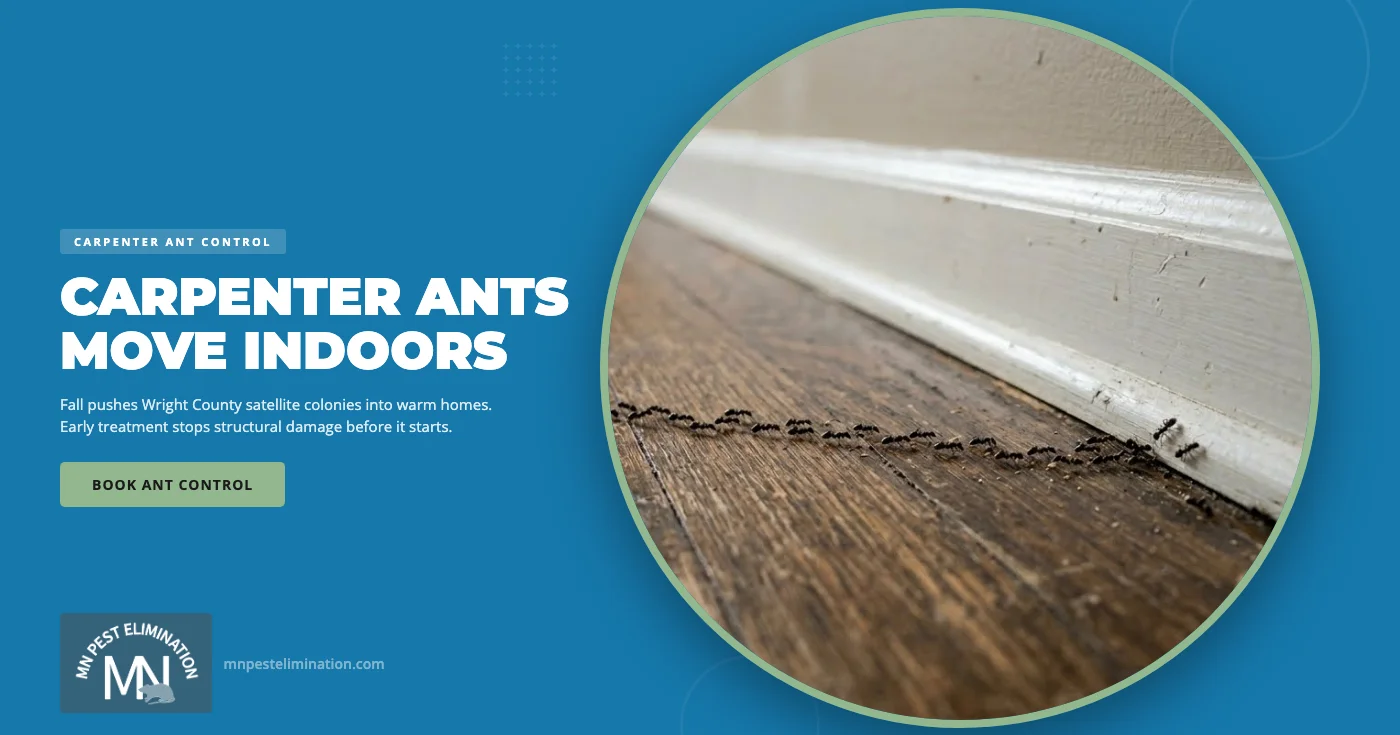
By mid-September in Montrose, MN, overnight lows are running in the 40s, corn along County Road 12 is drying down toward harvest, and the carpenter ant activity you noticed in the yard back in June has quietly moved somewhere else. Most Montrose homeowners assume that once summer ends the ants disappear with it. The colonies don't disappear — they relocate, and a lot of them relocate into your walls. Effective carpenter ant control Montrose MN homeowners actually get results from starts in September, before the fall interior push finishes and a satellite colony has settled into a soft sill plate for the winter.
Carpenter ants (Camponotus pennsylvanicus in most Wright County homes — the big black species) don't die off when temperatures drop, and they don't migrate south. Colonies survive Minnesota winters by slowing down inside protected nest sites, and when a satellite nest is inside a heated Montrose home, activity essentially never stops. NC State Extension research on the species notes that a mature parent colony holds 2,000 to 3,000 workers, produces 200 to 400 winged reproductives a year, and can push satellite nests hundreds of feet from the parent. That is why fall carpenter ant control Montrose MN properties really need is aimed at satellite nests, not just at the parent.
Fall is the transition. Once outdoor overnight lows drop below 50°F — which happens in Montrose most years by the second or third week of September — outdoor foraging drops sharply, the queen at the parent colony lays a second seasonal round of eggs, and satellite nests start consolidating into whatever warm, dry cavity is closest. In Wright County that cavity is very often a wall void, a hollow door frame, or a stretch of moisture-damaged sill plate on the north side of a Montrose home. By the first hard freeze in early October, most of the relocation is already done. Real carpenter ant control Montrose MN residents can rely on has to intercept the colony before it settles in.
The signs of a fall carpenter ant problem are quieter than the trailing lines of workers you saw across a patio in June, so a September or October walk-through of the low-traffic areas of your Montrose home is worth an hour of your time.
Frass. The single most diagnostic sign. Carpenter ants don't eat wood — they excavate it and push the debris out of the galleries. The result is small piles of what looks like sawdust mixed with dead-ant body parts, wing fragments, and bits of insulation, deposited below a tiny kick-out hole. Check window sills, basement corners, and behind stored boxes.
Large black ants indoors in cold weather. Workers run 1/4 to 5/8 inch long and are polymorphic — mixed sizes in one colony is normal. A single large black ant on the kitchen counter in November is a much stronger indoor-colony signal than a dozen in July: cold-weather indoor ants are almost certainly living inside the structure.
Winged reproductives indoors. Winged carpenter ants emerging from a wall vent, window frame, or basement corner on a warm late-winter day are a near-certain indicator of an established indoor nest. The University of Minnesota Extension flags indoor winged ants as diagnostic of an interior colony, not a foraging trail from outside.
Faint rustling in the walls. A large carpenter ant colony inside a wall void produces a soft, dry rustling — audible at night in a quiet Montrose bedroom. Once you know what you're listening for, it is hard to mistake.
Damaged wood with clean, smooth galleries. Pull trim off a suspect area and find tunnels sanded smooth and empty of dirt or mud — that is a carpenter ant gallery. Subterranean termite tunnels (rare in central Minnesota) are packed with mud-like material.
Once ants have moved a satellite nest indoors for the fall, the location is rarely random. Carpenter ant control Montrose MN homes need starts with knowing where to look — colonies target the same handful of cavity types on Wright County properties over and over.
Notice the pattern: parent nests need moisture, but satellite nests do not. A worker crew can overwinter in a dry wall void ten feet from a leaking window, and this is why sealing the visible water problem alone rarely eliminates the colony.
The single biggest predictor of a carpenter ant infestation in a Montrose home is wood with a moisture content above roughly 15 percent — the threshold NC State Extension identifies as the preferred nesting condition for the black carpenter ant. Any Wright County property with moisture-damaged wood, chronic leaks, or grade issues that hold water against structural members is running well above that threshold.
The moisture sources we identify most often on carpenter ant control calls across Montrose and the surrounding area are predictable and largely fixable:
The moisture-decay-ant cycle feeds itself. Damp wood attracts ants, ants excavate galleries, galleries let more air and moisture into the wood, decay accelerates, and softer wood makes the nest easier to expand. Any real carpenter ant control Montrose MN homeowners engage should include an honest look at the water sources around the structure.
Homeowners regularly ask us what works and what doesn't for do-it-yourself carpenter ant control Montrose MN properties can handle without a pro. The honest answer depends on how far the infestation has progressed and whether the parent nest is inside the structure or outside.
What can work as DIY. Slow-acting bait with hydramethylnon, avermectin, or boric acid placed along ant trails — especially near a suspected entry point — can knock down a small foraging population. The active ingredient has to be slow enough for foragers to carry it back to the nest before dying; NC State Extension notes 7 to 10 days for a functional bait to move through a colony. Fixing moisture problems, trimming vegetation a foot from siding, moving firewood 20 feet from the house, and sealing exterior gaps are all high-value DIY work.
What almost never works. Contact-kill sprays on ants you can see. All that does is kill a handful of workers, mask the pheromone trail, and often push the colony to split — turning one problem into two. Ultrasonic repellers have failed every peer-reviewed trial. Home remedies like cinnamon, vinegar, or coffee grounds do nothing to an established colony. Spraying insecticide where you have placed bait actively cancels the treatment.
What requires a pest management professional. The University of Minnesota Extension is direct: because carpenter ant nests are often hidden and difficult to locate, established infestations should be handled by a pro. That is doubly true when the colony is inside a wall void or frass has been showing up for weeks. Injection treatments into wall cavities, moisture-meter inspections, and targeted non-repellent applications along foraging routes are all outside the reach of over-the-counter products.
Any of the following are reasons to schedule carpenter ant control in Montrose with our team before winter locks the colony into your walls:
Our carpenter ant control Montrose MN service starts with a full-perimeter exterior inspection, an interior walk-through of moisture-prone areas and suspect voids, and a treatment plan matched to what we find. We use targeted non-repellent products applied to foraging routes and directly into identified nest voids, combined with an exterior perimeter treatment and written guidance on moisture, wood-to-soil, and vegetation contributors on your property. On established infestations we follow up within two to four weeks to verify the colony has been eliminated.
Do carpenter ants damage a home as fast as termites? No — carpenter ants excavate wood much more slowly than subterranean termites consume it, and a small indoor colony may take a year to cause meaningful damage. But unaddressed colonies grow, satellite-nest, and compound the damage over multiple seasons.
Will freezing weather kill the colony inside my walls? No. A wall void inside a heated Montrose home stays comfortably above freezing all winter, and the colony continues low-level activity until spring. Workers can also continue foraging in kitchens and pantries all winter if a food source is available.
How long does professional carpenter ant treatment take to work? A properly applied non-repellent or bait treatment typically shows a sharp drop in visible activity within one to two weeks, with the colony fully eliminated within a month. We schedule follow-ups to verify. If activity persists past that window, a second nest is usually present and needs to be located.
Can I just seal the entry point and be done with it? Sealing a visible entry after a colony is already established inside a wall void traps the colony in the structure and pushes workers to find a new exit — often into your kitchen or bathroom. Eliminate the colony first, then seal the entry.
Fall is the last practical window in Montrose to address carpenter ant activity before the colony settles into a heated wall void for the winter and becomes a much larger problem to eliminate in spring. If you have seen frass, heard rustling in a wall, or noticed large black ants indoors this September, reach out to us at MN Pest Elimination for carpenter ant control in Montrose. We serve Montrose, Waverly, Delano, Buffalo, Howard Lake, Hanover, Rockford, Annandale, Clearwater, and the surrounding Wright County area, and can usually schedule a fall inspection within a week. Contact MN Pest Elimination to get on the calendar before the first hard freeze locks the colony in.