Licensed and Insured. Holding permits through the MN DNR
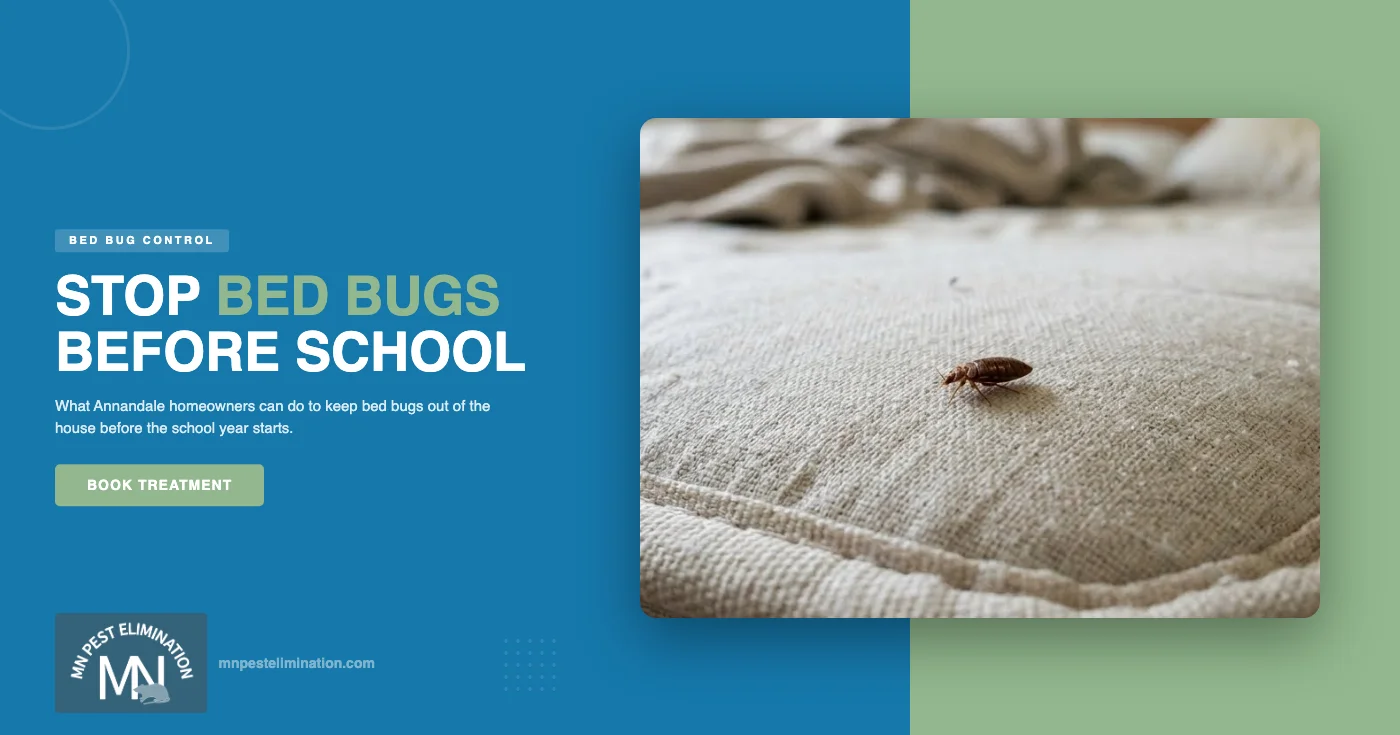
The last two weeks before the school year always change the shape of our week at MN Pest Elimination. Summer travel is winding down, cabins are closing up, and Twin Cities family visits are cycling through one more time. That combination is why late August is our highest-volume window for bed bug control in Annandale, MN and across Wright County. The bugs are not new — the exposures happened in June and July. Annandale families are just now noticing bites, dark specks along a mattress seam, or itchy welts on a child's ankles weeks after a lake weekend.
A bed bug problem caught in the first few weeks is a very different job than one caught in October. Here is what to look for before the first day of school — and where DIY steps make things worse.
Bed bug pressure in Annandale does not track weather the way mosquitoes and wasps do — it tracks travel. The Minnesota Department of Health notes that bed bugs have grown more common statewide largely because travelers keep coming into contact with infestations and unknowingly transporting them home. Our residential inspection volume climbs steadily from Memorial Day through the last weekend before school, and the days after Labor Day are the busiest of our year.
Late summer bed bugs MN homeowners find are almost always the delayed result of a June or July exposure. The University of Minnesota Extension reports that bed bug eggs hatch in six to ten days, and each nymph must feed before molting through five life stages. That biology creates a predictable lag — a handful of hitchhikers picked up over July 4 weekend can build into a noticeable population by mid-August. The back-to-school calendar amplifies it: backpacks come home from friends' houses, sleeping bags return from camps, and duffels come back from tournaments across the region.
Bed bugs do not fly and they do not jump. They hitchhike. The U.S. Environmental Protection Agency identifies travel as the primary way bed bugs spread between homes, which is why the EPA's guidance for travelers focuses almost entirely on inspection and heat treatment.
For Annandale households, the exposure points across a Minnesota summer are consistent year after year:
The pattern we see repeatedly in Annandale calls: a trip in early July, a low-grade sense that something is biting through late July, and a decisive call in mid-August after two family members wake up with welts on the same morning.
Bites are the sign most homeowners notice first and the least reliable one to trust. Some people react with raised, itchy welts in a line or cluster. Others show no visible reaction at all, even when their partner in the same bed is being bitten heavily. If only one family member is complaining, look at the physical evidence in the bedroom.
The subtlest sign that gets missed the most: welts that appear in the morning but not before bed. Bed bugs feed for two to five minutes and retreat, and the skin reaction can take hours to appear. If a household member keeps waking with new itchy bumps weeks after a summer trip, treat that as a warning worth investigating.
When we run a residential inspection in an Annandale home, we work in a predictable order because harborages follow biology. The bugs stay within a few feet of a sleeping host and radiate outward as the population grows.
The mattress. Strip every layer of bedding. Examine the piping seam around the top and bottom edges and check the four corners. Roll the mattress and check the underside.
The box spring. One of the two most common harborages in a Minnesota bedroom, and most homeowners never look here. Peel back the fabric dust cover at one corner and inspect the wooden interior frame with a flashlight.
The headboard and bed frame. Pull the bed away from the wall. Inspect the back of the headboard, the joints where rails meet posts, screw holes, and any recessed hardware.
Couches, recliners, and upholstered chairs. If anyone in your household naps on the couch or falls asleep in a recliner, treat that furniture like a second bed — cushion seams, welting around the arms, underside frame.
Baseboards, outlet covers, and the carpet edge. In heavier infestations, bugs spread outward from the bed. The seam where carpet meets baseboard and the edge of an outlet cover are late-stage harborages.
Backpacks, sports bags, and duffels. Right before the school year is the time to open every zipper channel, pocket seam, and lining corner of every travel bag in the house.
Every summer we get calls that begin the same way: "I looked everywhere and I cannot find them." Bed bugs are genuinely hard to locate for anyone who has not been trained to look for them. They are small and flat — adults slip into cracks no wider than the edge of a credit card, and eggs cement themselves into fabric corners a visual sweep misses. They are also nocturnal, emerging for two to five minutes to feed and then retreating, so a daytime inspection that does not pull back the box spring dust cover, remove the outlet plate behind the headboard, or check frame joints will simply miss them. And the reproductive math outpaces search: a single fertilized female lays 200 to 250 eggs, and those eggs hatch within ten days. What looked like nothing on a Sunday can be a well-established harborage two weeks later. That is the argument for a professional inspection when you have reason to suspect exposure.
What genuinely helps: heat. A clothes dryer on high for at least 30 minutes kills every life stage — the EPA specifically notes that time in a hot dryer kills bed bugs, whereas washing alone generally does not. A handheld steamer above 120°F kills bugs on contact along mattress seams. A zippered mattress and box spring encasement traps bugs inside until they starve. Vacuuming pulls visible bugs and eggs from cracks — empty the canister into a sealed plastic bag and put it in an outdoor trash can immediately.
What makes things worse:
When we get an Annandale MN bed bug exterminator call, we start with a full inspection rather than a quick walk-through. We confirm the species, locate every harborage, and assess how far the population has spread before any product is applied. That step alone catches the difference between a single hitchhiker brought home in a suitcase and an established population that needs whole-room treatment.
Our bed bug treatment Wright County MN protocol combines targeted residual products at harborage points with mechanical work that actually breaks the reproductive cycle — vacuuming, steam well above the 120°F lethal threshold, mattress and box spring encasement installation, and structured follow-up visits scheduled around the six-to-ten-day egg hatch window. Skipping that follow-up is the single most common reason a DIY job fails, because eggs laid before the initial treatment survive to become the next generation.
For Annandale families who want longer-term protection, our residential pest control program catches the broader pressure — ants, spiders, wasps, mosquitoes, rodents — alongside seasonal bed bug monitoring after summer travel.
Most Annandale families discover bed bugs two to six weeks after a trip. Eggs hatch in six to ten days, and the resulting nymphs need blood meals to grow. Bites typically appear once the population has been reproducing for two to four weeks — keep a closer eye on the bedroom for at least a month after any travel.
Washing alone is not reliable. The EPA and University of Minnesota Extension both recommend the dryer on high heat for at least 30 minutes as the step that reliably kills adults, nymphs, and eggs.
No. Bed bugs feed on blood, not crumbs or clutter. Spotless Annandale homes get them every summer — nearly always from travel.
Almost never. A treated mattress inside a zippered encasement performs identically to a new one, and bugs hiding in the box spring, headboard, and baseboards will reinfest a new mattress within days if the room is not treated.
The two weeks before the first day of school are the right window for Minnesota bed bug prevention in an Annandale home. Bags are still unpacked from the last cabin weekend, and a call handled in mid-August finishes on a normal schedule instead of colliding with October homework nights.
If a household member has been waking with unexplained welts, if you have found dark specks along a mattress seam, or if you want a professional set of eyes before the school year begins, reach out for bed bug control in Annandale, MN. At MN Pest Elimination we serve Annandale, Waverly, Montrose, Delano, Buffalo, Howard Lake, Hanover, Rockford, Clearwater, and the surrounding Wright County area. Contact MN Pest Elimination today to schedule an inspection and start the school year with the problem behind you.