Licensed and Insured. Holding permits through the MN DNR
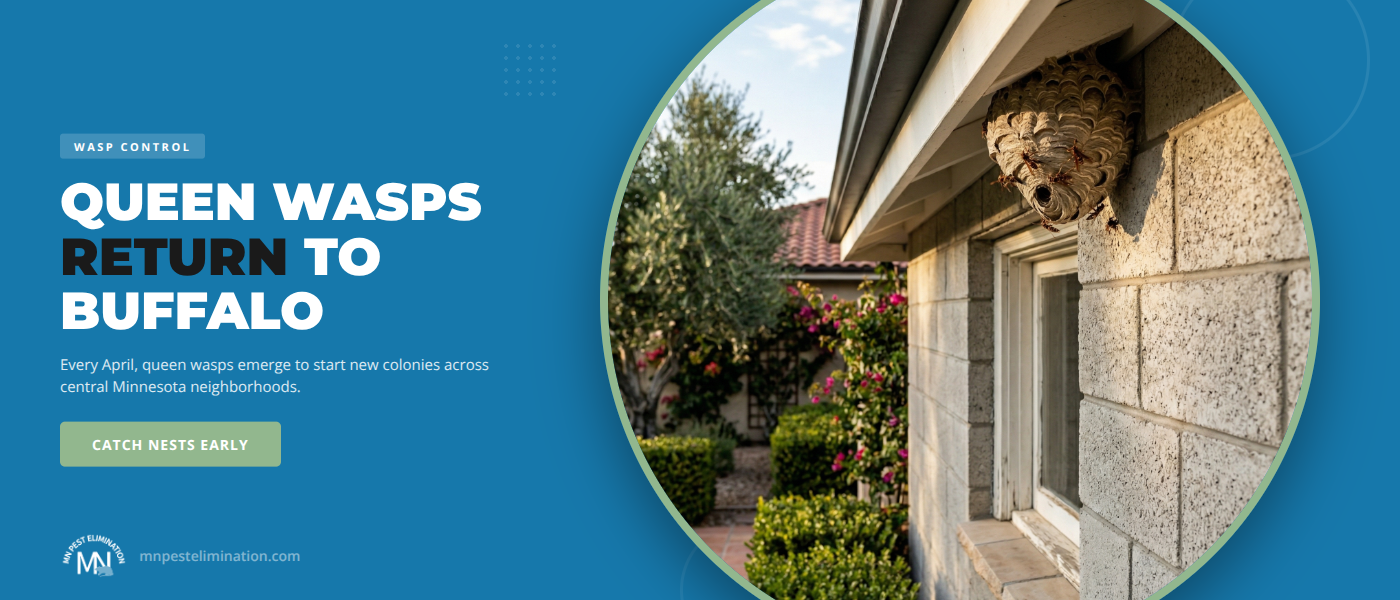
If you live in Buffalo, MN, you have probably noticed a few sluggish wasps bumping around your siding, deck rail, or shed door over the past couple of weeks. Those are not random scouts. They are queens — and every one of them is shopping for a place to build a new nest in your yard. Spring wasp season has officially started in Wright County, and the decisions homeowners make over the next few weeks will determine whether they spend July dodging stings around the grill or actually enjoying their backyard. At MN Pest Elimination, we specialize in wasp control Buffalo MN homeowners can rely on, and April is when our phone starts ringing for a reason.
Most people assume wasps are a midsummer problem. By the time you are swatting them off your deck in July, the colony has been growing for three months. According to the University of Minnesota Extension, wasp colonies are annual here — every nest you see in August was started by a single queen who survived winter alone, then emerged once temperatures climbed into the 50s and 60s. That window has now opened across Buffalo and Wright County.
A few specifics make our region especially active in spring. Buffalo sits between Lake Pulaski and Buffalo Lake, with hundreds of homes backing onto wooded shoreline that gives queens plenty of overwintering shelter. The freeze-thaw cycle through March pushes them deeper into siding, sheds, and woodpiles. When April delivers a string of warm days, every one of those hidden queens wakes up at roughly the same time. That is why you see a sudden burst of slow, single wasps before you see any actual nests. They are house-hunting — and stopping them now is dramatically easier than dealing with a 200-wasp colony two months from now.
Here is the part most homeowners do not realize: a queen wasp builds her first nest entirely by herself. There are no workers helping her in April. She is alone, vulnerable, and easy to disrupt — if you can find her.
After emerging, the queen chews dead wood — fence boards, weathered cedar siding, deck joists, old stumps — and mixes the fibers with saliva to make a paper pulp. She uses that pulp to build a small cluster of six-sided cells, usually 20 to 45 of them, hanging from a thin stalk. She lays an egg in each cell, then hunts soft-bodied insects to feed the larvae. For about 30 days, she is the entire workforce. Once that first batch of sterile female workers emerges, they take over construction and foraging, and the queen retreats to lay eggs for the rest of the season.
This 30-day solo phase is the critical window for queen wasp nest prevention in MN. A nest the size of a golf ball with one queen on it is a five-minute job to remove. The same nest in July, with hundreds of defensive workers, is a different animal entirely. Most of the wasp control Buffalo MN calls we run during late April and May are queens still on the founding cluster — we can shut them down before they ever become a real colony.
Queens are picky. They want a spot that is dry, sheltered from wind, gets some sun in the morning, and is close to a food source. On a typical Buffalo property, that puts the high-risk spots in some predictable places.
Walking your property this week, look for a single wasp landing in the same place repeatedly, a pencil-eraser-sized gray paper disk on a stalk, or a soft chewing sound from inside a soffit on a warm afternoon.
Treatment depends on what you are actually dealing with, and a lot of homeowners mistake one for the other. Here is how we sort them on a typical Buffalo service call.
Paper wasps are slender, half-inch to one-inch insects, brown with yellow markings, and their long legs hang down when they fly. Their nests are open, umbrella-shaped, and you can see right into the cells. The European paper wasp, an invasive species the UMN Extension flags as widespread in Minnesota now, looks more yellow-and-black and is often mistaken for a yellowjacket.
Yellowjackets are shorter, stockier, and brightly yellow-and-black with a distinct waist. They tuck their legs in tight when flying. Their nests are enclosed in a papery shell, often hidden underground or inside a wall void.
Bald-faced hornets are not actually hornets — they are a large yellowjacket species, about seven-eighths of an inch long, glossy black with cream-white face and abdomen markings. They build the football-shaped gray paper nests you see hanging from tree branches and high under eaves.
Honey bees and bumble bees are fuzzy, rounder, and golden-brown. They are pollinators, they are protected, and we never treat them as a pest problem. If you find honey bees on your property, we will refer you to a local beekeeper for a live removal. We treat wasps. We protect bees.
The reason spring wasp control matters in Buffalo, MN is not just nuisance. It is a real medical issue, especially for families with kids and dogs spending more time outside as the weather opens up.
Unlike honey bees, wasps and yellowjackets do not lose their stinger after one strike. A single wasp can sting repeatedly, and a disturbed colony — even an early one with only a handful of workers — will defend itself aggressively. Yellowjackets in particular will pursue a perceived threat 50 feet or more from the nest, which is exactly the distance from a soffit to a swing set in most yards.
For dogs, the risk is higher than most owners realize. Curious dogs snap at flying wasps and get stung in the mouth, throat, or tongue, where swelling can become a medical emergency. Underground yellowjacket nests are especially dangerous because a dog rolling in the grass or a kid running across the lawn can trigger the entire colony at once. According to the CDC, severe allergic reactions to wasp and hornet stings send tens of thousands of Americans to emergency rooms every year — and many did not know they were allergic until that first sting.
We get this call almost every week in late spring: "I sprayed the nest last night and now there are wasps everywhere." Here is what is actually happening.
Hardware store wasp sprays knock down what is sitting on the visible portion of the nest at the moment you spray. They do not penetrate the inner cells where larvae and the queen are sheltered, and they have almost no residual effect after the propellant evaporates. So you kill maybe 30 percent of the colony — usually the workers on the outside — and do three things that make the problem worse:
Underground yellowjacket nests are essentially impossible to treat with a consumer aerosol. The application angle is wrong, the nest entrance is too narrow for the spray to reach the chamber, and the homeowner is standing well within the colony's defensive radius the entire time.
Our spring wasp control Buffalo MN protocol is built specifically for the queen-and-founder window we are in right now. When you call us for wasp nest removal in Wright County MN, here is what we do.
We walk the property — every soffit, gable, shed corner, play set, plus a sweep of the lawn for in-ground entry holes — and find the nests homeowners cannot see from the deck. Then we apply a targeted, professional-grade product directly into the nest with the right delivery tool. For soffit and wall-void nests, that means a duster that pushes treatment deep into the cavity. For exposed paper nests, we use a fast-knockdown application that drops the colony at once instead of triggering a defensive response. For in-ground yellowjacket nests, we use a closed-system delivery that treats the chamber without putting our technician inside the swarm radius.
We remove the physical nest where it is reachable — leaving a dead nest in place invites a future queen to re-colonize the same spot next spring. Then we apply a residual perimeter treatment around the high-risk zones (eaves, soffits, deck rails, play structures) that discourages new queens from landing for the rest of the season. For homeowners who want long-term peace of mind, we offer ongoing service plans that include scheduled spring queen sweeps. You can see the full scope on our wasp control service page, or learn more about us at MN Pest Elimination.
Queens emerge once daytime temperatures hold consistently in the 50s and 60s, which in Buffalo, MN typically means mid-to-late April. Founding nests are usually visible by the first week of May. The full colony does not emerge until late June or early July.
Not necessarily — but you have a queen scouting the area. A single repeated visitor to the same spot over two or three days almost always means a nest is being built within 50 feet. That is the moment to call us.
The same colony will not — Minnesota wasp colonies die off every fall except for newly mated queens. But the location can absolutely be reused. Eaves and soffits that hosted a nest one year are statistically more likely to host one the next, which is why we recommend nest removal plus perimeter treatment together.
No. Despite the name, bald-faced hornets are a large yellowjacket species. They behave like yellowjackets, defend their nests like yellowjackets, and respond to the same treatment approach. The football-shaped gray paper nests in trees are the classic bald-faced hornet sign.
Spring is the one window where homeowners have the upper hand on wasps. The queens are alone, the nests are tiny, and a single visit can prevent a summer of stings. Once we hit June, the math flips hard in the wasps' favor.
If you have spotted a queen scouting your soffits or noticed a small paper cluster on your Buffalo property, do not wait. Reach out to MN Pest Elimination today — we will walk your property, find what is starting, and shut it down before it becomes a problem.