Licensed and Insured. Holding permits through the MN DNR
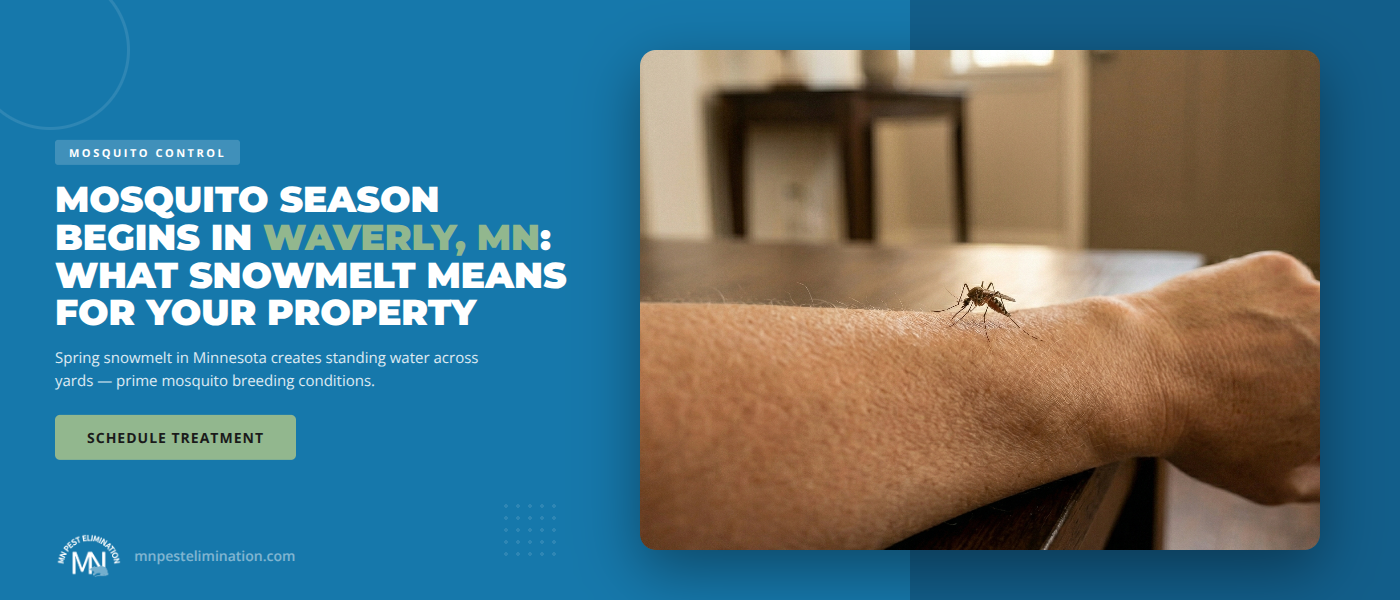
Spring arrives slowly in Waverly, MN, and so does mosquito season — but it arrives earlier than most homeowners expect. When the snow starts melting across Wright County, standing water collects in low spots, gutters, ditches, and yard depressions. That water becomes prime breeding ground for mosquitoes within days. If you've been searching for mosquito control Waverly MN residents can count on, you're already thinking ahead — and that's exactly the right approach.
Minnesota mosquitoes don't wait for summer. Female mosquitoes begin laying eggs as soon as temperatures stay consistently above 50°F. In central Minnesota, that window opens in late April and ramps up fast through May. By the time outdoor activities get into full swing — graduation parties, yard work, evening walks — mosquito populations can already be significant. The good news is that early action makes a real difference.
At MN Pest Elimination, we work with Waverly homeowners every spring to get ahead of mosquito season before it peaks. In this post, we'll walk through how snowmelt fuels mosquito breeding, what to watch for on your property, health risks specific to Wright County, and how professional treatment compares to DIY methods. By the end, you'll know exactly what steps to take to protect your family and reclaim your yard.
Most people associate mosquitoes with July heat, but the biology tells a different story. In Minnesota, the mosquito life cycle begins the moment standing water appears — and snowmelt provides that water in abundance. When several inches of snow thaw over frozen or saturated ground, the water has nowhere to go. It pools. It sits. And within a week of sustained warmth, it becomes a nursery.
Culex and Aedes mosquitoes, the two most common genera in Minnesota, use slightly different strategies. Aedes mosquitoes lay eggs in moist soil and leaf litter during fall. Those eggs survive the winter and hatch when spring moisture arrives. Culex mosquitoes overwinter as adults in sheltered spots and begin laying eggs in standing water once temperatures climb. Both strategies mean that the first warm weeks of spring in Waverly trigger simultaneous hatching from multiple mosquito populations at once.
The University of Minnesota Extension notes that snowmelt mosquitoes — particularly Aedes vexans — are among the most aggressive biters in the state. They can travel up to two miles from their breeding sites, which means that even if your own yard drains well, mosquitoes from neighboring fields or wetlands can still reach your property. Wright County's mix of agricultural land, wetlands, and residential neighborhoods creates conditions where populations build quickly once the season starts.
The practical takeaway: mosquito season in Waverly, MN typically begins in late April, with peak pressure arriving in June and July. Preparing before late April gives you the best chance of reducing populations before they reach nuisance levels.
Understanding where mosquitoes breed on your property is the first step toward controlling them. Mosquitoes only need about a bottle cap of standing water to complete their larval stage. That means almost any container or surface that holds water for more than a week can support a new generation. On a typical Waverly residential property, breeding sites tend to concentrate in a handful of predictable areas.
Walking your property with fresh eyes early in the season reveals more breeding sites than most homeowners expect. As part of our mosquito control service, we conduct a property assessment that identifies both obvious and hidden sources. Eliminating or treating these spots before populations peak is one of the most effective things you can do.
Mosquito bites are more than just itchy — they carry real health risks for Minnesota families. Wright County residents should be aware of the two primary disease concerns associated with local mosquito species: West Nile Virus and La Crosse Encephalitis.
West Nile Virus is transmitted primarily by Culex mosquitoes and has been documented in Minnesota every year since 2002. The Minnesota Department of Health tracks West Nile activity across the state each summer, and Wright County has seen confirmed human cases in past seasons. Most infected people experience no symptoms or only mild flu-like illness, but a small percentage develop serious neurological complications. Older adults and people with weakened immune systems face higher risk of severe outcomes.
La Crosse Encephalitis is a less common but serious illness primarily affecting children. It is spread by the eastern treehole mosquito, which breeds in exactly the kind of woodland edge habitat found in and around Waverly. While case numbers are low statewide, the consequences of infection in young children can be significant, including seizures and long-term neurological effects.
Beyond disease risk, the sheer volume of mosquitoes during peak season in Minnesota limits outdoor activity. Families lose hours of evening time in their own yards. Children's outdoor play gets cut short. Pets are affected, too — mosquitoes are a vector for heartworm in dogs and cats.
Reducing mosquito populations on your property directly reduces your family's exposure to these risks. It's not just about comfort — it's about protecting the well-being of everyone in your household throughout the summer months.
Before calling in professionals, there are meaningful steps every homeowner can take to reduce mosquito pressure. These actions won't eliminate the problem on their own, but they reduce the breeding population and make professional treatments more effective.
These steps are effective and worth doing every season. But for most Waverly properties — especially those near wetlands, open fields, or wooded areas — DIY prevention alone won't keep populations manageable through June, July, and August.
DIY prevention has real limits. If you've addressed standing water and kept your lawn trimmed but still feel swarmed every time you step outside, the breeding sources are likely beyond your property line — or deeper within your landscape than surface inspection reveals.
Here are clear signals that it's time to call a professional:
Professional treatment doesn't replace good property management — it works alongside it. When you contact MN Pest Elimination, we assess your specific situation and recommend a treatment plan based on your yard's layout, proximity to breeding sources, and seasonal conditions.
Our approach to mosquito control Waverly MN homeowners rely on combines source reduction, barrier treatment, and follow-up scheduling designed for Minnesota's season. We don't offer a one-size-fits-all spray and move on. Every property is different, and our service reflects that.
We start with a property walkthrough to identify breeding sites and high-activity resting zones. Mosquitoes spend most of their time in vegetation — under leaves, in shrubs, along fence lines — rather than flying in open air. Targeting these resting zones with barrier treatments significantly reduces adult populations within 24 to 48 hours of application.
Our treatments are applied to foliage, ground cover, and structural edges where mosquitoes rest during the day. We time applications to maximize residual effectiveness, typically scheduling treatments every three to four weeks through the active season. This recurring cadence keeps populations suppressed rather than allowing them to rebuild between visits.
We also provide service throughout our full Wright County service area, including Montrose, Delano, Buffalo, Howard Lake, Hanover, Rockford, Annandale, and Clearwater. Regardless of your specific location, our team brings the same level of attention and expertise to every property. If you have questions about what to expect or want to schedule an assessment, contact us here and we'll follow up promptly.
In addition to mosquito services, our team handles the full range of pest pressure that builds in spring and summer — from ant control as colonies emerge in May, to spider control as populations grow alongside insect prey, to rodent control for properties dealing with mice or voles along field edges. Managing multiple pest pressures under one service provider simplifies the process and keeps your home protected year-round.
Mosquito season in Minnesota doesn't end quickly. From first hatch in late April through the final population crash in September, you're looking at nearly five months of active pressure. Protecting your yard effectively requires a seasonal mindset rather than a single-event response.
We recommend Waverly homeowners think in three phases:
April – Early May (Pre-Season): Clean gutters, address drainage, remove overwintered containers from the yard, treat ornamental water features. Schedule your first professional barrier treatment before populations peak.
June – July (Peak Season): Maintain recurring professional treatments every three to four weeks. Continue weekly source elimination. Adjust outdoor activity schedules when populations are especially high following wet weather periods.
August – September (Late Season): Populations begin declining but remain significant, especially after late-summer rain events. Continue treatments through early September to protect fall outdoor use of your yard.
Consistency matters more than intensity. A season-long approach with professional barrier treatments and homeowner source management produces dramatically better results than a single spray in June. MN Pest Elimination structures our service packages around this seasonal reality so that Waverly families get protection when it counts most.
Mosquito season in Waverly, MN typically begins in late April when temperatures consistently reach 50°F or above. Snowmelt-triggered populations can produce biting mosquitoes by early May, with peak pressure arriving in June and July. Planning your first treatment before late April gives you the best head start on the season.
Yes — and it's one of the most underappreciated sources of early-season mosquito pressure. Aedes mosquito eggs laid the previous fall hatch as soon as spring moisture and warmth arrive. Pooling water from snowmelt provides ideal conditions for rapid hatching and larval development, sometimes producing large biting populations within two to three weeks of the first thaw.
Most properties benefit from treatments spaced three to four weeks apart throughout the active season — roughly late April through early September. That typically means four to six treatments depending on weather conditions and population pressure. We assess your property and recommend a schedule that matches your specific situation.
For most Waverly properties, especially those near wetlands, fields, or wooded areas, professional treatment provides substantially better results than DIY approaches. Barrier treatments target resting adult populations in vegetation, dramatically reducing the number of mosquitoes present within a day of application. Combined with source elimination, professional service can reduce biting pressure by 80 percent or more through the active season.
Spring in Wright County brings several pest pressures at once. Ants emerge and begin foraging indoors in May. Spiders build populations as insect prey becomes more abundant. Wasps begin establishing nests by late May and early June. Addressing these alongside mosquitoes — rather than reactively — keeps your home protected through the entire warm season. MN Pest Elimination handles all of these services across Waverly and the surrounding area.
Mosquito season in Waverly, MN arrives fast and builds quickly once snowmelt creates standing water across Wright County properties. The families who enjoy their yards most through the summer are the ones who plan ahead — eliminating breeding sources early and scheduling professional mosquito control Waverly MN residents trust before peak populations arrive.
At MN Pest Elimination, we've built our reputation on 5-star service across Waverly and the surrounding Wright County communities. We know the local pest pressures, the seasonal patterns, and the property types in this area. When you work with us, you're getting a team that understands exactly what your yard faces each spring — and how to keep your family's outdoor time enjoyable all season long.
Don't wait until mosquitoes are already a problem. Contact MN Pest Elimination today to schedule your property assessment and get ahead of mosquito season in Waverly.